Electronic Components Supplier | Transformers, Inductors, Inverters


PRODUCT PARAMETERS
Description
The rapid rise of Artificial Intelligence (AI) is impacting industries worldwide. Applications such as generative AI and advanced machine learning systems promise economic opportunity—but they also bring unprecedented energy demand growth. Meeting the electricity requirements of AI has become a critical challenge for the global energy system while also presenting the chance to accelerate investment in clean energy generation, advanced grid technologies, and energy storage.
Fluence has produced a detailed whitepaper outlining how battery storage systems can be deployed to address this challenge. Battery energy storage is uniquely suited to address the geographically concentrated and swiftly growing energy needs of AI technologies. By providing reliable, low-carbon power and supporting grid stability, battery energy storage systems (BESS) are poised to play a central role in powering AI while enabling the ongoing decarbonization of electricity networks.
Data Centers: At the Core of AI’s Energy Challenge
The growing influence of AI is driving significant technological changes, but its computational demands are presenting an equally profound energy challenge. Training large AI models like GPT-3 can consume up to 1,300 MWh of electricity—and AI assistance consumes ten times more energy than a standard internet search.
Data centers, the backbone of AI operations, are seeing unprecedented growth to support these demands. These facilities host the infrastructure required for AI development, training, and deployment and are expanding at an exponential rate. McKinsey estimates that global data center electricity demand could increase from 60 GW today to as much as 296 GW by 2030, with annual growth rates of up to 27%.
Meeting this energy demand is a race against time. While large-scale generation projects take years to come online, data centers need power now. Grid infrastructure in many regions is already under strain, exacerbating the challenge.
Battery energy storage is proving to be a pivotal solution, addressing the immediate need for reliable, low-carbon power to support AI operations while bolstering grid resilience for the future. By integrating storage into their energy procurement strategies, these companies can meet the demands of AI and set the stage for cleaner and more sustainable energy systems.
Global demand for data center capacity could more than triple by 2030
Demand for data center capacity, gigawatts
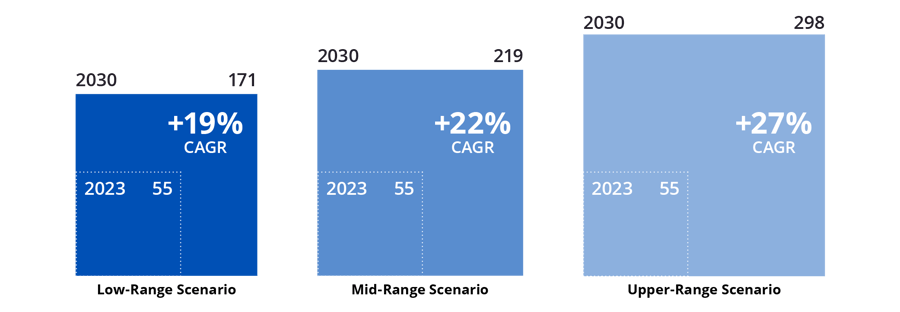 Three scenarios showing the low-, mid-, and upper-range estimates of demand, based on analysis of AI adoption trends; growth in shipments of different types of chips (application-specific integrated circuits, graphics, processing units, etc.) and associated power consumption; and the typical compute, storage, and networks needs of AI workloads. Demand is measured by power consumption to reflect the number of servers a facility can house. Source: McKinsey Data Center Demand model
The Role of Battery Energy Storage in Meeting AI Demand
As AI-driven electricity demand surges, battery storage systems are emerging as a key solution. These systems not only provide critical support to data center operations but also play an innovative role in enhancing the resilience and efficiency of the broader electricity grid. As detailed in more depth within Fluence’s whitepaper, here are three use cases that highlight how energy storage is ideally positioned to drive the AI revolution:
1. On-Site Energy Solutions
Battery storage can be deployed at or near data centers, typically referred to as “behind the meter”, but can still be done so at utility scale, providing reliable, low-emission power. Energy storage can form part of a microgrid solution or with a generation source that significantly reduces the maximum energy capacity required from the grid. This allows new proposed data centers to receive interconnection approval in a faster and less costly manner. In markets with a large number of data centers, utilizing battery energy storage to reduce the grid capacity needs can be one of the most valuable tools for new data center development.
Storage systems are also increasingly replacing diesel generators in backup applications. Gensets are costly to operate and emissions intensive. In backup applications, battery storage enables advanced functions like grid-forming and black start, allowing data centers to operate independently during grid outages.

2. Renewable Energy Power Purchase Agreements (PPAs) and Hybrid Projects
When paired with renewables, storage battery systems can deliver firm clean energy for large, guaranteed portions of the day, potentially around the clock depending on the duration of the battery and renewable generation. Importantly, co-located battery storage can help overcome project interconnection delays for generation requests, which are a persistent bottleneck in electricity networks globally.
3. Grid Support and Optimization
Beyond individual data center projects, storage can bolster the electricity network. Strategically placed storage systems ease congestion, optimize existing transmission infrastructure, and can act as virtual transmission assets.
Due to contingency planning for grid safety and reliability, transmission networks often operate below their maximum capacity. Battery energy storage can provide backup power functionality, freeing transmission lines to accommodate new renewable generation and serve high-demand loads, such as data centers.
Seizing the AI Energy Opportunity
This investment cycle presents both a challenge and sizable opportunity. Integrating battery energy storage into data center operations and renewable energy projects can unlock a cleaner, more resilient energy system. These technologies go beyond addressing immediate needs; they enhance grid reliability, lower emissions, and reduce energy costs for consumers.