


Leverancier van elektronische componenten | Transformatoren, Inductoren, Omvormers


Belangrijkste afhaalrestaurants
- The winding temperature indicator measures the simulated hotspot temperature of the transformer winding, niet de olietemperatuur.
- It provides alarm and trip contacts to prevent overheating damage and insulation failure.
- The indicator works by using a current transformer to heat a thermal element that mimics the winding’s thermal time constant.
- Proper selection, installatie, and maintenance are essential for accurate and reliable protection.
- A WTI is a critical component of a comprehensive transformer protection system, working alongside other devices.
What Is a Transformer Winding Temperature Indicator and Its Primary Function
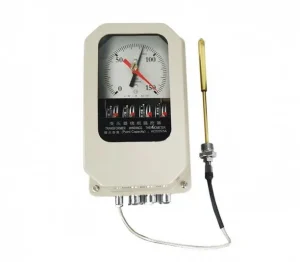
A transformer winding temperature indicator (WTI) continuously monitors the hottest point (hotspot) within a transformer winding. Its primary function is to detect excessive temperature rise that could damage winding insulation and provide early warning signals—typically alarm or trip contacts—so that operators can take corrective action before a failure occurs. By directly representing the thermal stress on the winding, the WTI protects the transformer’s most vulnerable component.
Unlike a simple oil temperature gauge, the WTI simulates the winding’s thermal behavior under varying load conditions. It uses a current transformer (CT) to sense load current, which heats a thermal element inside the indicator. The element’s time constant matches the winding’s thermal time constant, so the indicated temperature closely follows the actual hotspot temperature. When the temperature exceeds a preset threshold, the indicator triggers an alarm or initiates a trip circuit to isolate the transformer.
The WTI’s importance extends beyond immediate protection. Overheating degrades insulation paper and accelerates aging, reducing transformer service life. By providing timely temperature information, the WTI enables preventive maintenance, load management, and informed loading decisions. It is an essential component of any comprehensive transformer protection scheme, especially for oil-immersed power transformers.
Most WTIs include adjustable set points for alarm (typically around 90–110°C) and trip (around 110–130°C, depending on insulation class). When the simulated temperature reaches these thresholds, internal contacts close to energize external alarm panels or circuit breakers. Some advanced models also provide a continuous analog output (bijv., 4–20 mA) for remote monitoring and data logging, enabling integration with SCADA systems.
The accuracy of the WTI depends on proper matching of the CT ratio, heating resistor, and thermal time constant to the specific transformer. During installation, the CT must be connected to the correct phase and the thermal model calibrated to the transformer’s thermal characteristics. Regular testing verifies that the simulated temperature corresponds to the actual winding hotspot, ensuring reliable protection.
Key Features and Components of a Winding Temperature Indicator
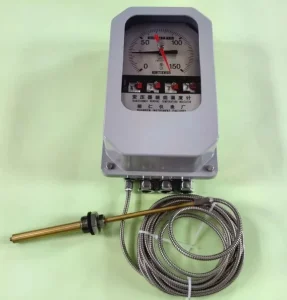
A winding temperature indicator comprises several key components that work together to perform accurate hotspot temperature monitoring. The current transformer provides the load signal, the heating resistor creates the thermal simulation, the temperature sensor converts heat to a measurable parameter, and the output contacts deliver alarm or trip signals. Many WTIs also include a visual dial or digital display showing the current temperature, and some have a self-test function to verify operation.
The table below summarizes the main features and their purposes.
Table: Winding Temperature Indicator Features and Descriptions
| Functie | Beschrijving |
|---|---|
| Hotspot Simulation | Simulates the winding hotspot temperature, not the average oil temperature, for accurate protection. |
| Adjustable Set Points | Allows user configuration of alarm and trip temperature thresholds based on transformer insulation class. |
| Output Contacts | Provides dry contact outputs for alarm and trip circuits, enabling direct connection to protection relays. |
| Analog Output | Optioneel 4-20 mA output for remote monitoring, data logging, and integration with SCADA systems. |
| Self-Test Function | Some models include a built-in self-test to verify the heating circuit and sensor integrity without external test equipment. |
Applications and Importance in Transformer Protection
Winding temperature indicators are widely used in oil-immersed power transformers, from small distribution units to large generator step-up transformers. They are also applicable to certain dry-type transformers using embedded temperature sensors. The WTI is especially critical for transformers with varying or high loads, because the winding hotspot temperature can rise rapidly under overload conditions, and the oil temperature alone may not reflect the true thermal stress.
The WTI directly monitors the hottest part of the winding—the point where insulation failure is most likely to occur. Insulation deterioration accelerates exponentially with temperature; a sustained increase of just 10°C can halve the life expectancy of the insulation. By providing early warning, the WTI allows operators to reduce load, activate cooling systems, or schedule maintenance before permanent damage occurs.
In a transformer protection system, the WTI works alongside other devices such as the Buchholz relay (for gas accumulation), overdrukventiel (for overpressure), and oil temperature indicator (for overall oil condition). Knowledge of Buchholz relay manufacturing, Buchholz-relaisvergelijking, En Buchholz relay selection helps engineers design a robust protection system. While the oil temperature indicator monitors the bulk oil temperature, the WTI gives a more precise and faster indication of winding thermal stress, making it indispensable for a comprehensive protection philosophy.
Tips for Selecting and Maintaining a Winding Temperature Indicator
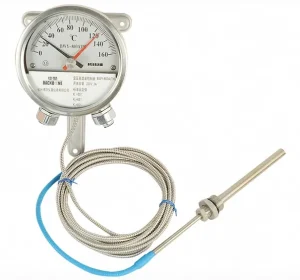
When selecting a winding temperature indicator, consider the transformer’s rated capacity, load profile, ambient temperature range, and required accuracy class. The CT ratio must match the transformer’s secondary current, and the thermal time constant of the indicator should match the winding’s thermal characteristics. Additional features such as multiple set points, analog output, and self-diagnostics can be beneficial for advanced monitoring systems.
Een juiste installatie is van cruciaal belang. The CT must be installed on the correct phase (usually the phase with the highest load) and the wiring must be free of poor connections that could affect the heating current. The indicator should be mounted in a location with minimal vibration and within its specified ambient temperature range. Na installatie, the set points must be verified against the transformer’s temperature limits and insulation class.
Regular maintenance includes periodic calibration of the temperature sensor and check of the output contacts. It is recommended to test the indicator’s response by injecting a known current and comparing the indicated temperature with the expected value. Any drift or deviation should be corrected, and the CT circuit should be inspected for corrosion or loose connections. A well-maintained WTI ensures reliable protection for decades.
Conclusie
The transformer winding temperature indicator serves a vital function: it continuously measures the simulated hotspot temperature of the winding and provides early warning signals to prevent overheating damage. By using thermal simulation that mirrors the winding’s thermal behavior, the WTI offers a direct and accurate representation of the thermal stress on the insulation.
For operators and engineers, the WTI is an indispensable tool for transformer protection, load management, and life extension. When properly selected, geïnstalleerd, and maintained, it contributes significantly to the safety and reliability of power systems. Understanding its function and ensuring its correct operation are key to avoiding costly transformer failures and unplanned outages.
Veelgestelde vragen
What is the difference between a winding temperature indicator (WTI) and an oil temperature indicator (KLAAR)?
A WTI measures the simulated hotspot temperature of the winding, while an OTI measures the top oil temperature. The WTI responds faster to load changes and provides a more accurate representation of the thermal stress on the winding insulation, which is critical for preventing hot-spot damage.
Can a winding temperature indicator be used on dry-type transformers?
Ja, dry-type transformers can use winding temperature indicators, typically with embedded temperature sensors (bijv., resistance temperature detectors) directly in the winding. The thermal simulation principle may differ from oil-immersed types, but the function of monitoring the hotspot temperature and triggering alarms remains the same.
Luoyang Datang Energietechnologie Co., Ltd. is een hightech onderneming die R&D, productie en levering van stroomapparatuur zoals transformatoren, nieuwe energiecomponenten, verdeelkasten en omvormers. Met technologische innovatie als kern, we richten ons op het creëren van zeer betrouwbare en krachtige energieoplossingen om wereldwijde klanten te bedienen. Met een strikt kwaliteitscontrolesysteem en internationale standaardcertificering, we blijven uitstekende producten produceren en stellen klanten in staat veilige en stabiele energiesystemen te bouwen.
GERELATEERDE POSTEN
Hybride omvormers: De ultieme oplossing voor de moderne energiebehoeften
Hoe silicagel-ontluchters transformatoren beschermen: Een complete gids

Snelle diodemodules en standaard diodemodules: Verschillen in werkingsprincipes, Kenmerken en toepassingen
Ringkernomvormer: De toekomst van efficiënte stroomconversie

Kan de ingebouwde omvormer water koken??
