Поставщик электронных компонентов | Трансформеры, Индукторы, Инверторы


Представьте себе 50 Силовой трансформатор МВА, работающий на солнечной электростанции в середине лета..
Сам трансформатор стоит сотни тысяч долларов.. It is designed to run for decades under heavy electrical load.
But one of the most critical protection devices on it is surprisingly small — a dial-type temperature indicator mounted on the tank wall.
Now imagine this situation:
- The oil temperature slowly rises
- Cooling fans fail to start on time
- Operators receive no warning
- The transformer keeps running under stress
A few hours or days later, serious insulation damage begins.
In many real-world cases, the root cause of transformer failure is not a major structural issue — but a missed temperature warning.
That is why the Transformer Индикатор температуры масла (СДЕЛАННЫЙ) is not just an accessory. It is a frontline protection device.
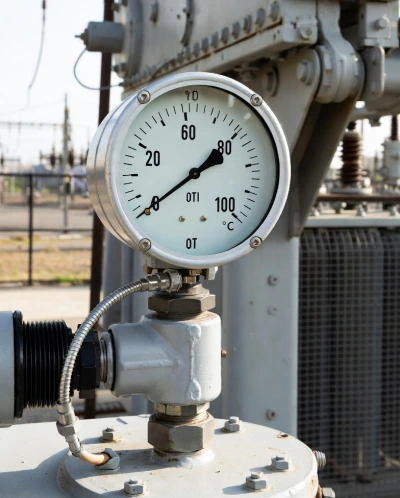
What Is a Transformer Oil Temperature Indicator?
A Transformer Oil Temperature Indicator (СДЕЛАННЫЙ) is a mechanical or electromechanical device used to measure the top oil temperature of an oil-immersed transformer.
Он обеспечивает:
- Local temperature display
- Over-temperature alarm signals
- Trip protection contacts
- Cooling fan control signals
Because transformer oil serves both as insulation and cooling medium, its temperature directly reflects the transformer’s operating condition.
In simple terms:
If oil temperature is under control, the transformer is usually safe.
If oil temperature is not controlled, everything else is at risk.
What Happens When Transformer Oil Temperature Gets Too High?
Transformer overheating does not usually happen suddenly.
It develops step by step:
Сначала, the temperature rises slightly above normal.
Then insulation aging accelerates.
Cooling systems work harder but become less effective.
В конце концов, small thermal stresses accumulate into serious internal damage.
By the time visible failure occurs, the problem has often been developing for weeks or months.
That is why utilities around the world rely on continuous oil temperature monitoring — not just for measurement, but for early warning.
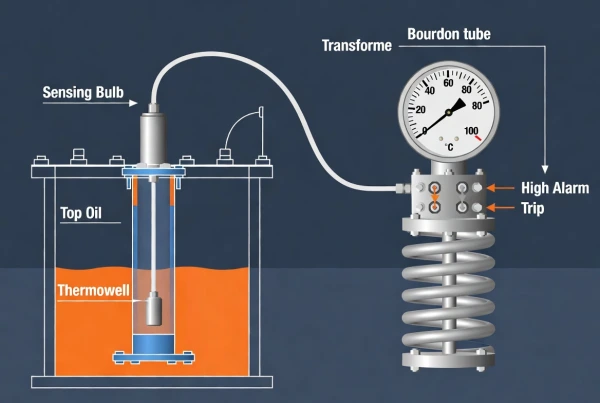
How Does a Transformer Oil Temperature Indicator Work?
Most traditional OTIs use a mechanical expansion system.
Он состоит из:
- Temperature sensing bulb
- Capillary tube
- Bourdon tube mechanism
- Dial pointer
- Adjustable electrical contacts
Step 1: Temperature Detection
The sensing bulb is installed inside a thermowell at the top oil region of the transformer.
Step 2: Thermal Expansion
As temperature increases, the liquid or gas inside the bulb expands.
Step 3: Pressure Transmission
The pressure is transmitted through the capillary tube.
Step 4: Mechanical Conversion
The pressure drives a Bourdon tube mechanism, moving the dial pointer.
Step 5: Protection Activation
When preset limits are reached:
- Alarm contacts activate warning signals
- Cooling fans start automatically
- Trip contacts may disconnect the transformer
This simple mechanical principle has been trusted in the power industry for decades because it is stable, robust, and independent of external power supply.
A Real-World Example from a Solar Power Plant
A solar farm operating in a high-temperature region installed multiple step-up transformers (33/132 кВ).
During peak summer operation, one transformer began showing slightly higher-than-normal oil temperature readings.
The OTI alarm was triggered before the temperature reached the trip level.
Maintenance engineers investigated and discovered a failed cooling fan that had stopped working.
Because the alarm activated early:
- The transformer remained in service
- Emergency shutdown was avoided
- Expensive downtime was prevented
Without the OTI alarm, the overheating condition could have gone unnoticed until severe insulation damage occurred.
This is a typical example of why temperature monitoring is considered a critical protection function, not just an indicator.
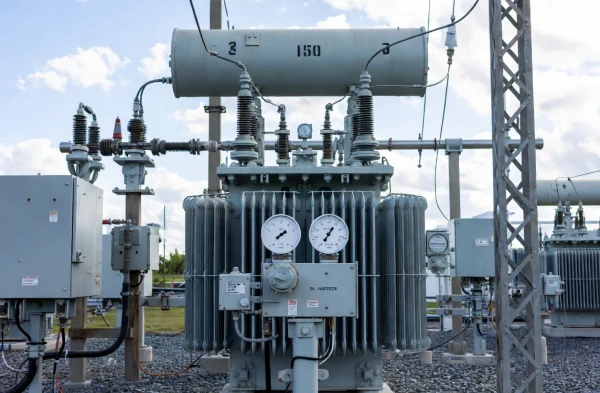
7 Critical Factors Buyers Must Check Before Ordering
Many buyers compare only price.
Experienced buyers compare specifications and reliability.
Below are the 7 most important factors you must check before purchasing a transformer oil temperature indicator.
1. Температурный диапазон
Different transformers operate under different thermal conditions.
Общие диапазоны включают:
- 0°C to 120°C
- 0°C to 150°C
- 20°C to 160°C
For most power and distribution transformers, 0°C to 150°C is the most widely used option.
2. Alarm and Trip Contact Configuration
This is one of the most frequently misunderstood specifications.
Typical configurations include:
- 1 Alarm + 1 Trip
- 2 Alarms + 1 Trip
- Fan control contacts
Incorrect configuration can lead to system incompatibility with transformer protection panels.
Always confirm:
- Contact quantity
- Contact rating
- Setpoint adjustability
3. Capillary Tube Length
The capillary connects the sensing bulb to the indicator.
Common lengths:
- 3 метры
- 5 метры
- 7 метры
- 10 метры
A wrong selection may cause installation difficulty or unnecessary cost increase.
4. Accuracy and Calibration
Accuracy typically ranges:
- Сорт 1.0
- Сорт 1.5
Higher accuracy ensures better protection response.
For utility-grade projects, calibration certificates are usually required.
5. Environmental Protection Level
Transformers are often installed outdoors in harsh environments.
The indicator should withstand:
- Дождь
- Пыль
- UV exposure
- Temperature fluctuations
Recommended protection levels:
- IP55
- IP65
6. Compliance with International Standards
Large projects often require compliance with:
- стандарты МЭК
- ANSI standards
- Utility technical specifications
Non-compliance can lead to rejection during project inspection or commissioning.
7. Manufacturer Capability and Quality Control
A reliable supplier is more important than a low price.
Check whether the manufacturer can provide:
- Factory test reports
- Calibration records
- Export documentation
- Custom design options
- Technical support for installation
In transformer projects, poor-quality accessories often cause more problems than the transformer itself.
OTI vs WTI: What Is the Difference?
Many buyers confuse Oil Temperature Indicator (СДЕЛАННЫЙ) with Winding Temperature Indicator (WTI).
| Особенность | СДЕЛАННЫЙ | WTI |
|---|---|---|
| Measures | Температура масла | Температура обмотки |
| System complexity | Простой | More complex |
| Расходы | Ниже | Выше |
| Уровень защиты | Basic thermal monitoring | Advanced overload protection |
| Приложение | Распределительные трансформаторы | Силовые трансформаторы |
When OTI Is Enough
For standard distribution transformers, OTI provides sufficient monitoring.
When WTI Is Required
For high-capacity or critical transformers, utilities often install both systems together.
Common Problems and What They Really Mean
1. Incorrect Temperature Reading
Often caused by calibration drift or sensor aging.
2. Contact Failure
Usually related to worn or low-quality contact materials.
3. Capillary Leakage
Caused by mechanical damage or manufacturing defects.
4. Pointer Sticking
Often related to internal mechanical wear or contamination.
These issues are not just “failures” — they are often indicators of product quality differences between suppliers.
Where Are Oil Temperature Indicators Used?
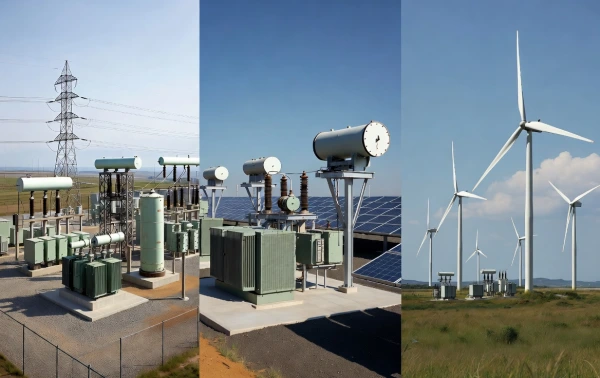
OTIs are widely used in:
- Power substations
- Солнечные электростанции
- Ветровые электростанции
- Industrial factories
- Mining and steel plants
- Data centers and critical infrastructure
Any system that depends on transformer reliability requires proper temperature monitoring.
How to Choose a Reliable OTI Manufacturer
When selecting a supplier, avoid focusing only on unit price.
Вместо, evaluate:
Engineering Experience
Do they specialize in transformer accessories?
Production Quality
Do they perform calibration and testing?
Export Experience
Do they understand international project documentation?
Customization Capability
Can they adjust:
- Dial design
- Capillary length
- Contact configuration
Technical Support
Can they support troubleshooting and installation guidance?
A good supplier reduces project risk — not just cost.
Часто задаваемые вопросы
Can a faulty OTI damage a transformer?
Да. If temperature is not accurately monitored, cooling systems may fail to activate in time.
Why do some transformers use both OTI and WTI?
Because oil temperature and winding temperature reflect different thermal conditions.
Is digital OTI better than mechanical OTI?
Digital versions offer remote monitoring, but mechanical OTIs are still preferred for reliability and independence from power supply.
How long does an OTI last?
A high-quality unit can typically operate for many years under normal conditions, depending on environment and maintenance.
Заключение: Why OTI Matters More Than Most Buyers Think
Although small in size and relatively low in cost, the Transformer Oil Temperature Indicator plays a critical role in transformer safety.
It is often the first device to detect abnormal operating conditions — and in many real-world cases, it is the difference between normal operation and expensive failure.
When selecting an OTI, buyers should not treat it as a simple accessory.
It should be treated as a protection component for a high-value electrical asset.
Choosing the right specification and the right manufacturer directly impacts transformer reliability, maintenance cost, и безопасность системы.
Ищем надежные аксессуары для трансформаторов?
We supply a full range of transformer protection and monitoring devices, включая:
- Oil Temperature Indicators (СДЕЛАННЫЙ)
- Winding Temperature Indicators (WTI)
- Magnetic Oil Level Gauges (MOG)
- Pressure Relief Devices (ПРД)
- Дыхалки из силикагеля
Contact us for technical support and quotation for your project.
ПОХОЖИЕ ПОСТЫ

Раскрытие нового энергетического потенциала: Популярность сетевых инверторов
Сетка в переходный период: Освоение интеграции переменных возобновляемых источников энергии
Как выбрать подходящий тиристорный диодный модуль??

Насколько маленьким может быть инвертор?
Высокоэффективные и интеллектуальные трансформаторы для зарядных станций электромобилей