전자 부품 공급업체 | 트랜스포머, 인덕터, 인버터


사람들이 FIFA 월드컵을 기억할 때, 그들은 챔피언을 기억한다.
아르헨티나 2022.
프랑스 2018.
독일 2014.
하지만 축구팬들에게 절대 잊지 못할 순간에 대해 묻는다면, many won’t talk about the winners.
They’ll talk about the mistakes.
A goalkeeper dropping the ball.
A defender making an own goal.
A referee missing a critical call.
Ninety minutes of brilliant teamwork can be destroyed by a mistake that lasts three seconds.
The same thing happens in the power industry.
A utility company may spend millions of dollars on a new transformer project.
Engineers spend months on design.
Procurement teams negotiate contracts.
Manufacturers perform factory testing.
Logistics teams move equipment across continents.
Everything looks perfect.
Then a small component fails.
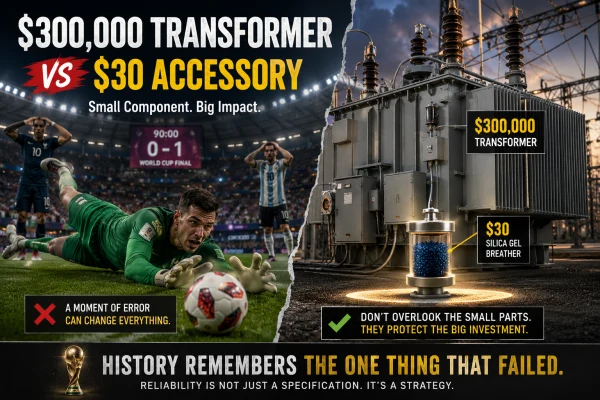
A blocked Silica Gel Breather allows moisture into the tank.
An inaccurate Oil Level Indicator provides false readings.
A Pressure Relief Valve fails to operate during an internal fault.
Suddenly, the entire project is remembered not for its success, but for its failure.
This is why experienced buyers rarely ask only one question:
“How much does the transformer cost?”
대신에, they ask:
“What could cause this transformer to fail five years from now?”
That question changes everything.
Because reliability is not built by the largest component.
It is built by the weakest one.
Football teaches the same lesson every four years.
Championships are won by teams.
But championships are often lost by a single overlooked detail.
Transformers are no different.
The most expensive component is not always the transformer itself.
Sometimes it is the $30 accessory nobody paid attention to.
And just like the World Cup, history rarely remembers the thousands of things that worked perfectly.
It remembers the one thing that didn’t.