전자 부품 공급업체 | 트랜스포머, 인덕터, 인버터


전력 변압기에 사용되는 많은 보호 장치 중, 그만큼 부흐홀츠 릴레이 is widely regarded as one of the most important safeguards for oil-immersed transformers. 침묵의 수호자 역할을 하다, it can detect the earliest signs of internal faults and respond before minor issues escalate into costly failures, 장비 손상, or widespread power outages.
But what exactly is a Buchholz Relay? 어떻게 작동하나요?? And why is it considered indispensable in large oil-filled transformers around the world?
Let’s take a closer look.
부흐홀츠 계전기란??
A Buchholz Relay is a gas-actuated protection device installed in the pipe connecting the main transformer tank and the conservator tank of an oil-immersed transformer.
Invented by German engineer Max Buchholz ~에 1921, this relay is specifically designed to detect internal transformer faults. It continuously monitors the presence of gases generated by insulation breakdown, partial discharges, winding faults, 과열, and other abnormal conditions occurring inside the transformer.
By identifying these warning signs early, the Buchholz Relay helps prevent severe damage and improves overall transformer reliability.
Installation Location: Why Position Matters
The Buchholz Relay is installed between the conservator tank and the main transformer tank, as shown below:
Conservator Tank
       │
       │  Connecting Pipe
 ┌──────────┐
 │ Buchholz │
 │  Relay   │
 └──────────┘
       │
       │
Main Transformer Tank
This location is critical because gases generated by internal faults naturally rise through the oil and travel toward the conservator tank. By placing the relay directly in this path, it can effectively detect fault-related gas accumulation and oil movement.
How Does a Buchholz Relay Work?
The operating principle of a Buchholz Relay is based on two distinct fault conditions: gas accumulation 그리고 oil surge.
1. Gas Accumulation: Early Warning for Minor Faults
When a transformer experiences minor internal problems such as:
- 절연 노화
- 부분방전
- Core overheating
- Loose electrical connections
the insulating oil begins to decompose slowly, producing small amounts of gas.
As these gases rise and accumulate inside the relay chamber, the oil level within the relay drops. This causes the upper float to descend and activate the alarm contact.
At this stage:
✅ An alarm signal is sent to the control room.
❌ The transformer continues operating normally.
This early warning allows maintenance personnel to investigate and address the issue before it develops into a serious failure.
2. Oil Surge: Immediate Response to Major Faults
When severe internal faults occur, ~와 같은:
- Inter-turn winding short circuits
- Phase-to-phase faults
- Ground faults
- Heavy arcing
the pressure inside the transformer rises rapidly.
This sudden pressure increase creates a high-velocity oil flow toward the conservator tank. The oil surge pushes a flap or vane inside the Buchholz Relay, triggering the trip contact.
At this stage:
✅ A trip signal is generated immediately.
✅ The circuit breaker disconnects the transformer.
✅ Further damage is prevented.
The entire process typically takes only milliseconds to a few seconds, significantly reducing the risk of catastrophic transformer failure.
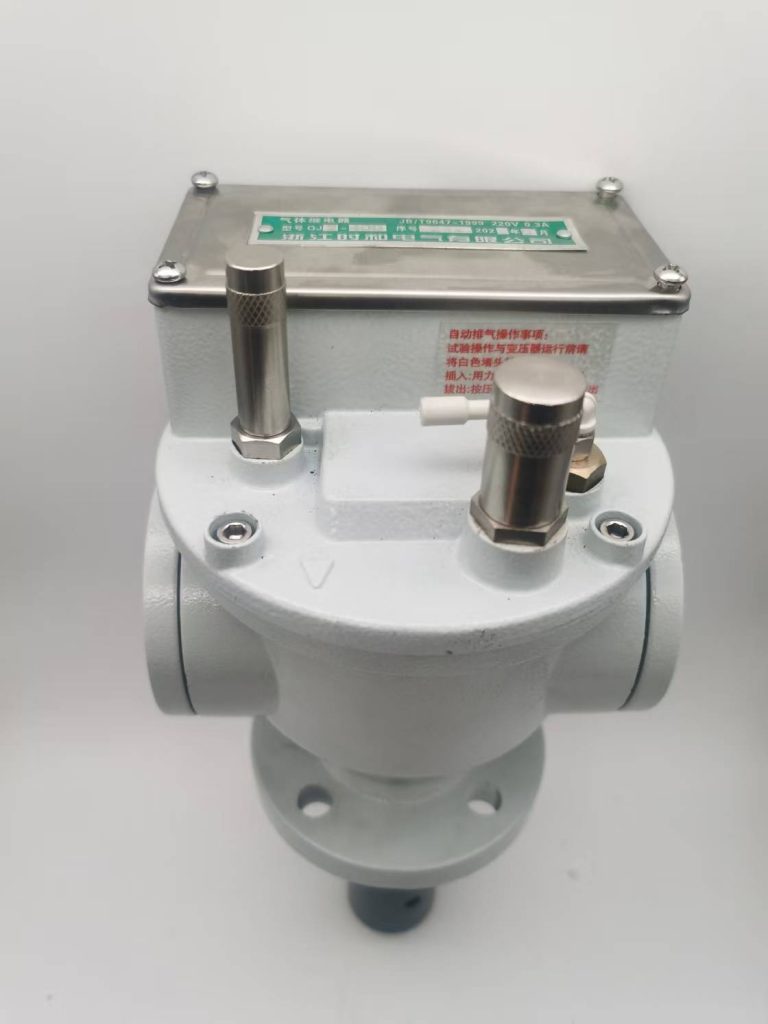
Main Components of a Buchholz Relay
Although relatively simple in design, the Buchholz Relay contains several essential components:
Float System
Monitors oil level changes caused by gas accumulation.
Flap or Vane Mechanism
Detects sudden oil movement caused by severe faults.
Alarm Contacts
Operate during minor faults and send warning signals.
Trip Contacts
Operate during major faults and initiate transformer shutdown.
Gas Sampling Valve
Allows maintenance personnel to collect gas samples for diagnostic analysis.
Why Is the Buchholz Relay So Important?
1. Early Fault Detection
Many transformer failures begin as small internal defects that are difficult to detect through external monitoring.
Conditions such as:
- Partial discharges
- Localized overheating
- Insulation deterioration
often generate gases long before they become critical.
The Buchholz Relay acts as an early warning system, helping operators identify and resolve issues before serious damage occurs.
2. Protection of High-Value Assets
Power transformers represent a major investment. Large utility transformers can cost hundreds of thousands or even millions of dollars.
Without rapid fault detection and isolation, internal faults may result in:
- Burned windings
- Tank rupture
- 화재 위험
- Extended power outages
The fast-acting trip function of the Buchholz Relay helps minimize these risks and protect valuable equipment.
3. Improved Power Supply Reliability
Modern power systems require uninterrupted operation.
By detecting internal abnormalities at an early stage, the Buchholz Relay enables planned maintenance rather than emergency repairs, reducing unexpected outages and improving grid reliability.
4. Supports Dissolved Gas Analysis (DGA)
The gas sampling valve on the relay allows operators to collect fault gases for 용존 가스 분석 (DGA).
Different gases indicate different fault types:
| Gas Type | Possible Fault |
|---|---|
| Hydrogen (H₂) | 부분방전 |
| Methane (CH₄) | Low-temperature overheating |
| 에틸렌 (C2H₄) | High-temperature overheating |
| 아세틸렌 (C₂H₂) | Arcing fault |
| Carbon Monoxide (CO) | Paper insulation degradation |
This information helps engineers determine both the nature and severity of transformer faults.
Limitations of the Buchholz Relay
Despite its effectiveness, the Buchholz Relay is not a complete protection solution.
Applicable Only to Conservator-Type Transformers
Sealed transformers without conservator tanks cannot utilize a Buchholz Relay.
Cannot Detect External Faults
The relay does not respond to:
- External short circuits
- Lightning surges
- System overloads
Additional protection systems such as differential protection and overcurrent relays are required.
Requires Proper Installation and Maintenance
Incorrect installation or inadequate maintenance can compromise its performance.
Maintenance Recommendations
To ensure reliable operation, regular inspections should include:
- Visual condition checks
- Oil leakage inspection
- Alarm circuit testing
- Trip circuit testing
- Float and flap operation testing
- Gas sampling and DGA evaluation
A comprehensive inspection is generally recommended at least once per year.
작가
PDDN – Power Distribution & New Energy Solutions
PDDN specializes in transformers, 변전소, , solar energy systems, 에너지 저장 솔루션, and integrated power infrastructure projects. Our engineering team is committed to providing reliable electrical equipment and technical expertise for utility, 산업의, and renewable energy applications worldwide.