Soláthraí Comhpháirteanna Leictreonacha | Claochladáin, Ionduchtóirí, Inverters


Siopaí beir leat eochair
- OIP bushings use oil-impregnated paper insulation and require periodic oil maintenance, Cé go n-úsáideann bushings RIP páipéar soladach líonta roisín agus tá siad saor ó chothabháil.
- Tá bushings OIP ar fheabhas i ardvoltas, high-thermal-load applications but have leakage risks; RIP bushings are ideal for compact, indoor, or environmentally sensitive installations.
- Total cost of ownership for RIP bushings can be lower due to reduced maintenance, despite a potentially higher initial cost.
- The choice depends on voltage level, coinníollacha comhshaoil, cumais chothabhála, and installation constraints.
Understanding OIP and RIP Transformer Bushings
When selecting transformer bushings, neither OIP nor RIP designs are universally better; the optimal choice depends on your application’s voltage level, coinníollacha comhshaoil, cumais chothabhála, and long-term operational goals. The key differences are compared below to help you make an informed decision.
OIP bushings have been used for decades in high-voltage and extra-high-voltage transformers. They consist of paper insulation impregnated with transformer oil, offering high dielectric strength and thermal performance. The oil acts as both an insulator and a coolant. RIP bushings, by contrast, use a resin-impregnated paper core that is cured to form a solid, dry insulation system. This design eliminates the need for oil, making them compact, éadrom, agus saor ó chothabháil.
Both types share the same fundamental purpose: to safely carry high-voltage current through a transformer tank wall. Their construction and operating principles result in different performance characteristics.
Construction and Design Differences
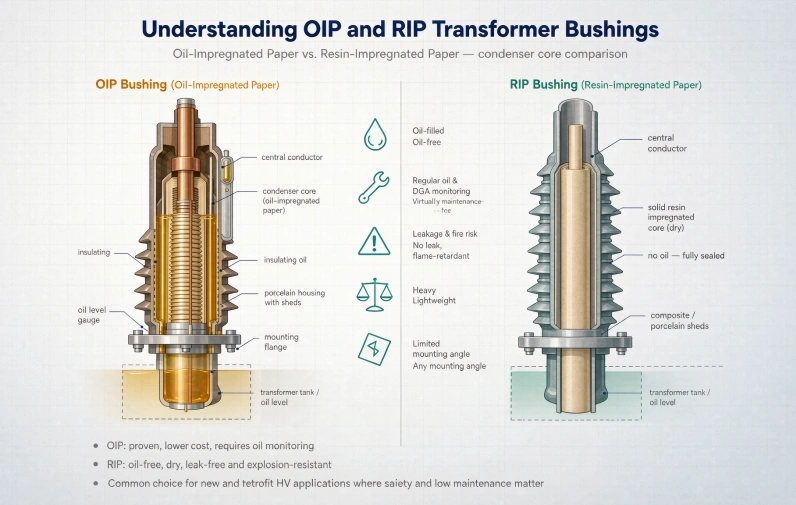
The core difference between OIP and RIP bushings is their insulation medium and how it is maintained. OIP bushings rely on a continuous oil-impregnated paper winding that must remain filled with oil under positive pressure. They typically include an oil reservoir, pressure gauge, sampling port, and a breather glóthach shilice to control moisture in the expansion space. The oil serves as both insulation and heat transfer medium. I gcodarsnacht leis sin, RIP bushings use a resin-impregnated paper core that is fully cured, creating a solid, homogeneous insulation. No additional liquid or gas is required.
RIP bushings are generally more compact and lighter than their OIP counterparts for the same voltage rating. The solid insulation allows flexible mounting orientations, while OIP bushings often require vertical or near-vertical installation to maintain proper oil circulation. The RIP design eliminates the risk of oil leakage, a concern in OIP bushings, especially in seismic zones or areas with extreme temperature fluctuations.
The following table summarizes the key structural and design differences between the two bushing types.
| Toise Comparáide | OIP Bushing | RIP Bushing |
|---|---|---|
| Meán inslithe | Páipéar ola-líonta | Páipéar líonta roisín (soladach) |
| Modh fuaraithe | Oil circulation | Heat conduction through solid insulation |
| Riachtanais chothabhála | Periodic oil sampling, scagachán, potential oil replacement | Íosráta; no oil handling needed |
| Feidhmchláir tipiciúla | High-voltage power transformers, outdoor substations | Indoor substations, GIS, offshore, compact transformers |
| Lifespan | Long with proper maintenance; oil degradation is a factor | Long; insulation is sealed and stable |
| Costas | Moderate initial cost; higher ongoing maintenance costs | Slightly higher initial cost; lower total cost of ownership |
| Environmental sensitivity | Riosca sceitheadh ola; requires spill containment | Oil-free; suitable for sensitive environments |
| Installation orientation | Usually vertical or near-vertical | Flexible orientation possible |
Performance and Application Comparison
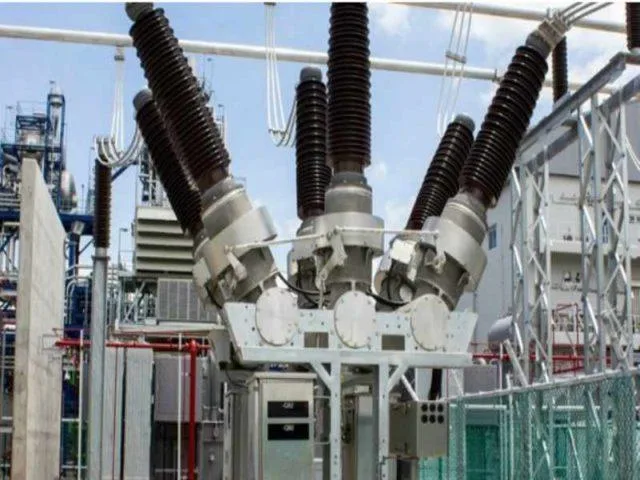
OIP bushings offer high dielectric strength and can handle high thermal loads. The oil provides excellent heat dissipation, making them suitable for heavy continuous loads and high short-circuit currents. They are widely used in power transformers, especially at voltage levels above 110 kV, where their long track record of reliability is valued, and are often paired with a sealaíochta Buchholz for gas accumulation detection. Mar sin féin, OIP bushings require periodic oil testing, scagachán, and possibly oil replacement. They are also more susceptible to moisture ingress if the seal is compromised.
RIP bushings provide low partial discharge levels and high dielectric stability over their lifetime. Since the insulation is solid and sealed, they are virtually maintenance-free. They are suitable for indoor substations, offshore platforms, and other environments where oil spill risk or maintenance access is limited. RIP bushings are increasingly used in medium-voltage to high-voltage applications, including gas-insulated substations (GIS) and compact transformer designs. Their lower weight and reduced footprint simplify installation and structural requirements.
Both types can be designed with capacitive grading layers to control the electric field distribution. The choice often depends on life-cycle cost, environmental policies, and operational preferences. Utilities with established oil handling infrastructure may prefer OIP, while those seeking minimal maintenance and environmental risk may lean toward RIP.
Cost and Maintenance Considerations
Initial purchase cost for OIP and RIP bushings is comparable, with differences depending on voltage class and customization. OIP bushings may have a slightly lower upfront cost, but they incur ongoing expenses for oil testing, monatóireacht, and potential oil replacement. The required oil sampling and handling equipment, lena n-áirítear táscairí leibhéal ola, increases total cost of ownership. Ina theannta sin, oil leakage or contamination can lead to transformer downtime and repair costs.
RIP bushings may have a higher initial cost in some cases but offer lower total cost of ownership due to reduced maintenance needs. The solid insulation does not require oil sampling, and the sealed design reduces the risk of unexpected failures. Their longer service life and reliability in harsh conditions can offset the initial investment. For applications where maintenance access is difficult or expensive, RIP bushings are often the more economical option over the transformer’s lifespan.
Making the Right Choice for Your Application
To choose between OIP and RIP bushings, consider your application’s voltage level, coinníollacha comhshaoil, cumais chothabhála, and long-term cost goals. OIP bushings remain a proven, high-performance option for traditional high-voltage transformers, especially where oil handling infrastructure exists. They are suitable for outdoor installations with regular maintenance schedules.
RIP bushings are well-suited for modern, dlúth, and environmentally sensitive installations. They are particularly suitable for indoor substations, offshore projects, and areas with extreme climates or seismic activity. Their dry, maintenance-free design reduces operational risk and simplifies compliance with environmental regulations. Both technologies can deliver reliable performance when matched to the right application. Consulting with a transformer bushing manufacturer can help you evaluate specific design parameters and ensure the best fit for your project.
Ceisteanna coitianta
Can OIP bushings be used indoors?
Tá, but they require proper oil containment and ventilation to manage leakage risk and oil vapor. Many indoor installations use RIP bushings to avoid these concerns.
Are RIP bushings suitable for extra-high voltage (EHV) iarratais?
Tá, RIP bushings are available for EHV classes and are increasingly used in modern substations. Mar sin féin, OIP bushings have a longer history of use at the highest voltages. The specific voltage rating and design must be evaluated for each project.
How do I choose between OIP and RIP for a new transformer?
Consider the transformer’s voltage class, suíomh (indoor/outdoor, seismic zone, climate), maintenance access, environmental regulations, and life-cycle cost. Consulting with a manufacturer can provide design-specific guidance.
Luoyang Datang Energy Technology Co., Teo. Is fiontar ardteicneolaíochta é R&D, déantúsaíocht agus soláthar trealaimh chumhachta amhail claochladáin, comhpháirteanna fuinnimh nua, caibinéid dáileacháin agus inverters. Le nuálaíocht teicneolaíochta mar chroílár, dírímid ar réitigh chumhachta ard-iontaofachta agus ardfheidhmíochta a chruthú chun freastal ar chustaiméirí domhanda. Le córas rialaithe cáilíochta dian agus deimhniú caighdeánach idirnáisiúnta, leanaimid ar aghaidh ag aschur táirgí den scoth agus cuirimid ar chumas custaiméirí córais chumhachta atá sábháilte agus cobhsaí a thógáil.
POSTAÍ GAOLMHARA

Conas do ghairdín a ghealú gan glaoch ar leictreoir

thyristor SCR – an rogha éifeachtach agus iontaofa i rialú cumhachta
Cáblaí Trasfhoirmeora Reatha: Sonraí Trick Tarchuradóirí le haghaidh Uathoibriú Cumhachta agus Réiteach Rialaithe
Ceartaitheoir Tonn Iomlán: Prionsabal Oibre, Cineálacha, agus Feidhmchláir
Praghsanna Inverter i 2024: Treochtaí, Coigiltis, agus Leideanna Ceannaigh Chliste