Proveedor de componentes electrónicos | Transformadores, Inductores, Inversores


Conclusiones clave
- OIP bushings use oil-impregnated paper insulation and require periodic oil maintenance, mientras que los casquillos RIP utilizan papel sólido impregnado de resina y no requieren mantenimiento.
- Los casquillos OIP destacan en alto voltaje, high-thermal-load applications but have leakage risks; RIP bushings are ideal for compact, indoor, or environmentally sensitive installations.
- Total cost of ownership for RIP bushings can be lower due to reduced maintenance, despite a potentially higher initial cost.
- The choice depends on voltage level, condiciones ambientales, capacidades de mantenimiento, and installation constraints.
Understanding OIP and RIP Transformer Bushings
When selecting transformer bushings, neither OIP nor RIP designs are universally better; the optimal choice depends on your application’s voltage level, condiciones ambientales, capacidades de mantenimiento, and long-term operational goals. The key differences are compared below to help you make an informed decision.
OIP bushings have been used for decades in high-voltage and extra-high-voltage transformers. They consist of paper insulation impregnated with transformer oil, offering high dielectric strength and thermal performance. The oil acts as both an insulator and a coolant. RIP bushings, by contrast, use a resin-impregnated paper core that is cured to form a solid, dry insulation system. This design eliminates the need for oil, making them compact, ligero, y sin mantenimiento.
Both types share the same fundamental purpose: to safely carry high-voltage current through a transformer tank wall. Their construction and operating principles result in different performance characteristics.
Construction and Design Differences
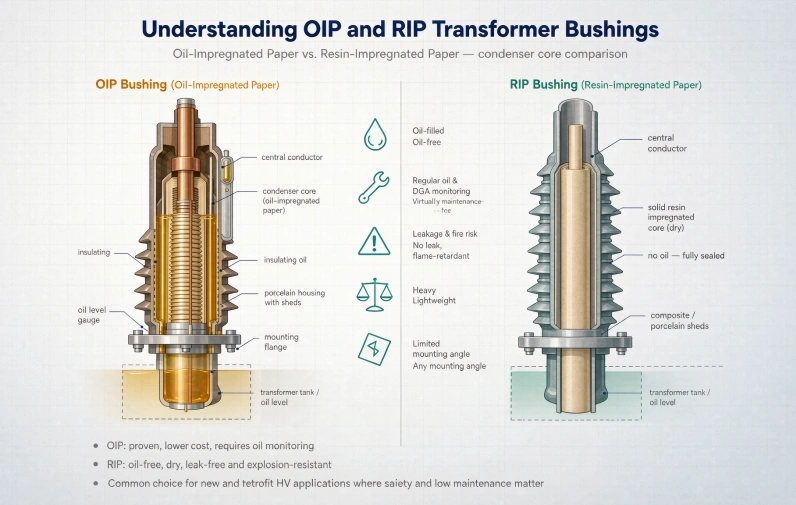
The core difference between OIP and RIP bushings is their insulation medium and how it is maintained. OIP bushings rely on a continuous oil-impregnated paper winding that must remain filled with oil under positive pressure. They typically include an oil reservoir, pressure gauge, sampling port, and a respirador de gel de sílice to control moisture in the expansion space. The oil serves as both insulation and heat transfer medium. En contraste, RIP bushings use a resin-impregnated paper core that is fully cured, creating a solid, homogeneous insulation. No additional liquid or gas is required.
RIP bushings are generally more compact and lighter than their OIP counterparts for the same voltage rating. The solid insulation allows flexible mounting orientations, while OIP bushings often require vertical or near-vertical installation to maintain proper oil circulation. The RIP design eliminates the risk of oil leakage, a concern in OIP bushings, especially in seismic zones or areas with extreme temperature fluctuations.
The following table summarizes the key structural and design differences between the two bushing types.
| Dimensión de comparación | Buje OIP | Buje RIP |
|---|---|---|
| Medio de aislamiento | Papel impregnado de aceite | Papel impregnado de resina (sólido) |
| Cooling method | Oil circulation | Heat conduction through solid insulation |
| Requisitos de mantenimiento | Periodic oil sampling, filtración, potential oil replacement | Mínimo; no oil handling needed |
| Typical applications | High-voltage power transformers, outdoor substations | Indoor substations, SIG, offshore, compact transformers |
| Lifespan | Long with proper maintenance; oil degradation is a factor | Long; insulation is sealed and stable |
| Costo | Moderate initial cost; higher ongoing maintenance costs | Slightly higher initial cost; lower total cost of ownership |
| Environmental sensitivity | Riesgo de fuga de aceite; requires spill containment | Oil-free; suitable for sensitive environments |
| Installation orientation | Usually vertical or near-vertical | Flexible orientation possible |
Performance and Application Comparison
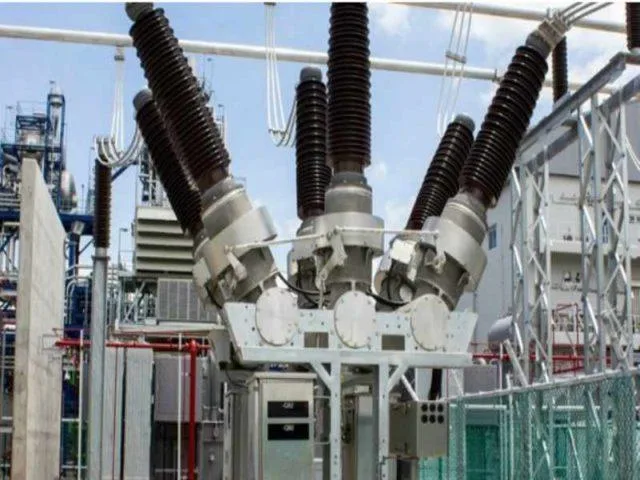
OIP bushings offer high dielectric strength and can handle high thermal loads. The oil provides excellent heat dissipation, making them suitable for heavy continuous loads and high short-circuit currents. They are widely used in power transformers, especially at voltage levels above 110 kV, where their long track record of reliability is valued, and are often paired with a Relevo Buchholz for gas accumulation detection. Sin embargo, OIP bushings require periodic oil testing, filtración, and possibly oil replacement. They are also more susceptible to moisture ingress if the seal is compromised.
RIP bushings provide low partial discharge levels and high dielectric stability over their lifetime. Since the insulation is solid and sealed, they are virtually maintenance-free. They are suitable for indoor substations, offshore platforms, and other environments where oil spill risk or maintenance access is limited. RIP bushings are increasingly used in medium-voltage to high-voltage applications, including gas-insulated substations (SIG) and compact transformer designs. Their lower weight and reduced footprint simplify installation and structural requirements.
Both types can be designed with capacitive grading layers to control the electric field distribution. The choice often depends on life-cycle cost, environmental policies, and operational preferences. Utilities with established oil handling infrastructure may prefer OIP, while those seeking minimal maintenance and environmental risk may lean toward RIP.
Cost and Maintenance Considerations
Initial purchase cost for OIP and RIP bushings is comparable, with differences depending on voltage class and customization. OIP bushings may have a slightly lower upfront cost, but they incur ongoing expenses for oil testing, escucha, and potential oil replacement. The required oil sampling and handling equipment, incluido indicadores de nivel de aceite, increases total cost of ownership. Además, oil leakage or contamination can lead to transformer downtime and repair costs.
RIP bushings may have a higher initial cost in some cases but offer lower total cost of ownership due to reduced maintenance needs. The solid insulation does not require oil sampling, and the sealed design reduces the risk of unexpected failures. Their longer service life and reliability in harsh conditions can offset the initial investment. For applications where maintenance access is difficult or expensive, RIP bushings are often the more economical option over the transformer’s lifespan.
Making the Right Choice for Your Application
To choose between OIP and RIP bushings, consider your application’s voltage level, condiciones ambientales, capacidades de mantenimiento, and long-term cost goals. OIP bushings remain a proven, high-performance option for traditional high-voltage transformers, especially where oil handling infrastructure exists. They are suitable for outdoor installations with regular maintenance schedules.
RIP bushings are well-suited for modern, compacto, and environmentally sensitive installations. They are particularly suitable for indoor substations, offshore projects, and areas with extreme climates or seismic activity. Their dry, maintenance-free design reduces operational risk and simplifies compliance with environmental regulations. Both technologies can deliver reliable performance when matched to the right application. Consulting with a transformer bushing manufacturer can help you evaluate specific design parameters and ensure the best fit for your project.
Preguntas frecuentes
Can OIP bushings be used indoors?
Sí, but they require proper oil containment and ventilation to manage leakage risk and oil vapor. Many indoor installations use RIP bushings to avoid these concerns.
Are RIP bushings suitable for extra-high voltage (EHV) aplicaciones?
Sí, RIP bushings are available for EHV classes and are increasingly used in modern substations. Sin embargo, OIP bushings have a longer history of use at the highest voltages. The specific voltage rating and design must be evaluated for each project.
How do I choose between OIP and RIP for a new transformer?
Consider the transformer’s voltage class, location (indoor/outdoor, seismic zone, climate), maintenance access, environmental regulations, and life-cycle cost. Consulting with a manufacturer can provide design-specific guidance.
Tecnología de energía Co. de Luoyang Datang., Limitado. es una empresa de alta tecnología que integra R&D, Fabricación y suministro de equipos eléctricos como transformadores., nuevos componentes energéticos, armarios de distribución e inversores. Con la innovación tecnológica como eje, Nos enfocamos en crear soluciones de energía de alta confiabilidad y alto rendimiento para servir a clientes globales.. Con un estricto sistema de control de calidad y certificación de estándares internacionales., Continuamos produciendo productos excelentes y permitimos a los clientes construir sistemas de energía seguros y estables..
PUBLICACIONES RELACIONADAS

¿Cómo funciona un inversor SCR??
Tiristores controlados por fase discreta: La innovación en electrónica de potencia conduce al futuro

¿Qué tan eficiente es el inversor solar conectado a la red??

Transformador de estación de carga para vehículos eléctricos: Tipos, Diseño y requisitos técnicos

Cómo los disipadores de calor grandes pueden mejorar el rendimiento de los dispositivos electrónicos