
Articles
Battery Cells vs. Battery Modules for Energy Storage: Which Is Right for Your Project?
Cells and modules are only 25–45% of BESS capex. Learn how to decide which layer to buy at—by scale, chemistry, cold tolerance, and augmentation strategy.
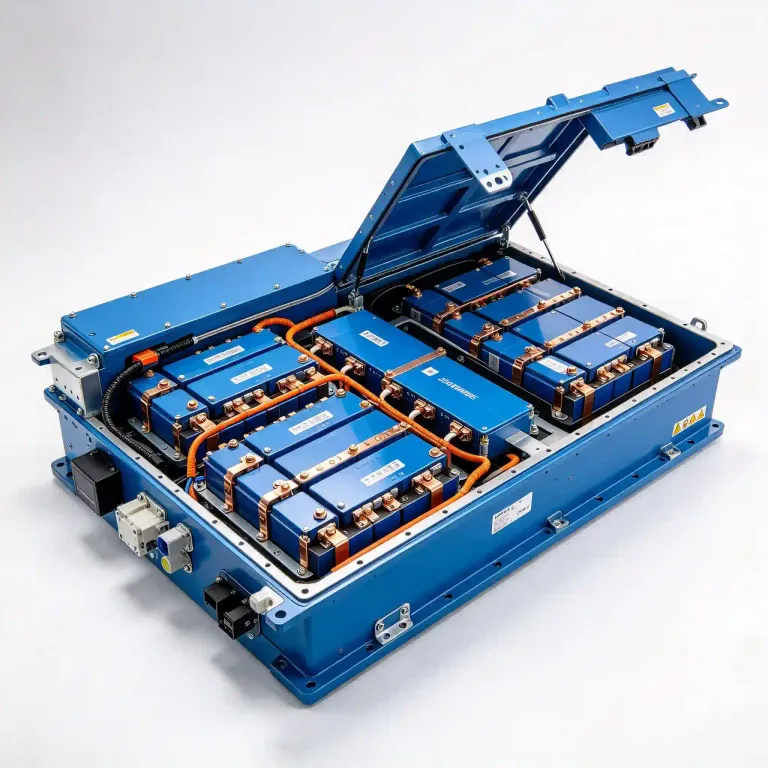
Most storage vendors open with a spec sheet. Let's not. Here's the number that reframes the whole debate: in 2026, cells and modules together make up only 25%–45% of total BESS capital expenditure. The other 55%–75% goes to PCS, balance of system, thermal management, permitting, interconnection, and execution risk.
So “cell or module” is not a fight over the biggest line item. It's a fight over where complexity lives, who owns it, and what it costs to fix something at 2 a.m. three years from now.
The hierarchy, in one table
Every layer adds structure, conductors, sensing—and a boundary at which you can or cannot intervene in the field. A cell is chemistry and voltage. A module is where that chemistry becomes maintainable. That single shift explains almost every trade-off downstream.
Layer | What it adds | Field-replaceable? | Decision meaning |
|---|---|---|---|
Cell | Chemistry, voltage platform, energy-density ceiling | No | Failure = replace at module/rack level |
Module | Frame, busbars, sampling, often module | Limited | Minimum serviceable unit |
Pack | Series/parallel architecture, thermal interface | Rare | Integration moves into factory |
Rack/String | System protection, comms | No | Architecture choice lives here |
Container | HVAC, fire suppression, controls | No | Where NFPA 855 separation applies |
Where this portfolio actually sits
This is where cell-vs-module stops being abstract. The portfolio spans the full hierarchy—which is exactly what makes a project-level recommendation possible instead of a one-size-fits-all pitch.
Layer | Products in this portfolio | Best-fit duty |
|---|---|---|
46950 3.2V 32Ah Cylindrical LFP · 105Ah 3.2V Prismatic LFP · 3.7V 62.5Ah Prismatic NMC · 3.7V 71Ah E71 Pouch | High-count compact racks; standardized formats | |
Cell | LTO40 2.4V 45Ah LTO · 3.2V 210Ah LF280K Na-ion · 3.2V 440Ah PT-6887 Blade | Deep cold, high cycle, or large-format integration |
24V 160Ah Na-ion 1P8S · 16S1P NMC 59.2V 218Ah · 96V/144V/192V LFP Modules | C&I racks; pre-validated building blocks | |
Pack | Custom 18650 LFP Pack 3.7V–24V, 1S–4S · Cylindrical Li-ion Module 50/20/10Ah | End-user or installer-ready assemblies |
Notice the logic: it is not “module beats cell.” It is match the product layer to the layer your project team can actually execute. If your team can't do cell-level work safely and repeatably, buying cells is buying risk.
Chemistry cheat sheet: pick by duty, not by hype
Cold-climate projects and high-cycle projects don't have the same “best chemistry.” Here's the honest split.
Chemistry | Standout strength | Watch-out | In this portfolio |
|---|---|---|---|
Cost, cycle life, thermal stability | Cold derating without heating | 46950 32Ah · 105Ah · 96/144/192V modules | |
−50°C to +60°C operation; ~25,000 cycles @80% DoD | Higher cost per kWh | LTO40 2.4V 45Ah | |
Na-ion | Cold tolerance; supply-chain diversification | Energy density below LFP | LF280K 210Ah · 24V 160Ah module |
Energy density per rack | Propagation needs module-level design | 62.5Ah cell · 16S1P 59.2V 218Ah module | |
Blade / large-format | Fewer cells, fewer connections per MWh | Thermal & serviceability engineering load | PT-6887 440Ah |
A quick data anchor: research-grade Na-ion chemistries have shown 92.5% capacity retention at −35°C, with measurable capacity down to −40°C. LTO's cycle-life class sits around 25,000 cycles at 80% depth of discharge. These are the numbers that make chemistry a project decision, not a preference.
What modularity buys—and what it charges you
Modularity is usually sold as “easier maintenance.” True, but incomplete. What it really does is move integration labor from the project site to the supplier's factory floor—and price it into the module.
What you gain
- Fault isolation at the module boundary
- Faster field replacement, shorter downtime
- Mid-life augmentation without tearing down a rack
- Pre-validated sub-assemblies cut commissioning labor
What you pay
- Frame, busbar, and harness mass per kWh
- Module unit price carries factory integration cost
- Combustible structural material inventory rises
- Cell-to-system integration efficiency trails CTP
The hidden variable that flips the decision is augmentation strategy over project life. If you'll add capacity mid-life, or downtime carries a hard commercial penalty, the module premium is buying an option on operational continuity. If neither holds, that premium is harder to defend—and the cell-side or CTP route deserves a serious look, provided the thermal and safety engineering is real, not slideware.
Safety is a layer question
UL 9540A lays out the ladder clearly. Cell-level testing comes first. If thermal runaway can't be initiated at cell level—or vent gas is nonflammable—higher-level testing may not be required. But if cell-level propagation is possible, module-level testing is where you learn whether one cell failure stays inside its module or seeds the next. A module-level test passes in the propagation sense when runaway is contained within the module.
NFPA 855's default 3 ft (914 mm) separation between ESS units exists because propagation is a system-level property, reducible only with fire and explosion test data.
The takeaway
- LFP changes cell-level failure propensity—not module-frame behavior
- The module is a different safety boundary, not an automatically safer one
- Demand module-level UL 9540A results, not just cell-level
Project-scale cheat sheet
Utility-scale (≥10 MWh, 4h+)
- Real question is rack/container architecture, not cell-vs-module
- Large-format cells + CTP can cut internal complexity and assembly cost
- If mid-life augmentation is financed in, module replaceability keeps option value
- Data to demand: module-level UL 9540A
C&I (100 kWh–few MWh)
- Modules near-default—not because cells are worse, but because sites lack cell-level labor and tooling
- Cold-storage and high-latitude sites: evaluate LTO or Na-ion before defaulting to LFP
- Fit: 96/144/192V LFP modules, 24V 160Ah Na-ion module, 16S1P NMC 59.2V 218Ah
Residential / small commercial (<100 kWh)
- Buyer purchases a pack or finished system
- Cell-vs-module is less operational, but shapes what installers can service
- Fit: Custom 18650 LFP pack with matched BMS
The bottom line
No chemistry or format wins on every axis. LTO owns deep cold and extreme cycling. Na-ion buys cold tolerance and supply-chain diversification. Large-format LFP and blade cells rewrite the cell-side integration math. NMC modules deliver energy density per rack. Cylindrical formats give standardization at cell count.
The right question is not “cell or module.” It is: at which layer does my team stop being able to execute safely, repeatably, and at acceptable lifecycle cost? Put the product boundary there. Above it, you buy. Below it, you engineer.
Not sure which layer your project should buy at?
Answer three questions and Luoyang Datang Energy Tech Co., Ltd. will tell you where the product boundary belongs—not just which SKU to quote.
# | Question | Why we ask |
|---|---|---|
1 | Project scale & duration? | Determines rack/container architecture |
2 | Operating temperature range & cycle target? | Decides whether LFP, LTO, or Na-ion fits |
3 | Will you augment capacity mid-life? | Decides whether module premium pays back |
Send your project brief → | Talk to an engineer →
Response within one business day. No auto-quote spam.