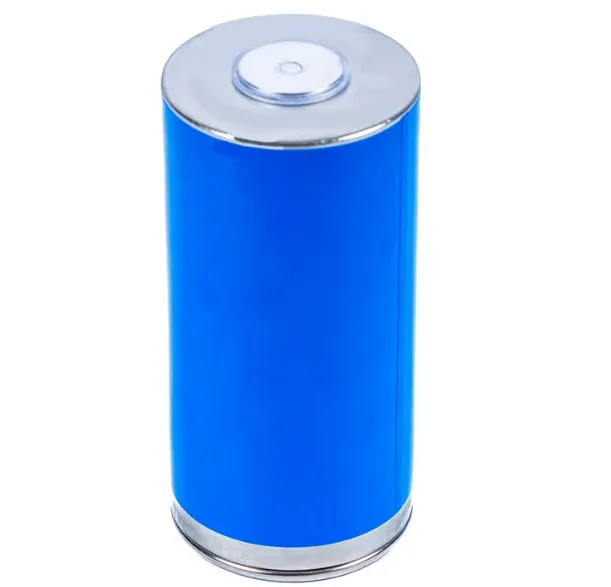
Product Overview
Cylindrical cells wind the electrode stack into a cylindrical “jelly roll” sealed in a metal can. They are the most standardized and automation-compatible lithium-ion format, spanning 18650, 21700, 26650, and the large-format 4680 / 4695. The defining recent change is the tabless architecture in 46-series cells: current collection moves from localized tabs to the full current-collector edge, reducing internal resistance by 50–80% and shortening the current path by 60–80%. Cells are supplied as components; welding, interconnection, thermal interface, and BMS are implemented at module and pack level.
Key Features
- Standardization is the core advantage. 18650 and 21700 share mature, high-throughput winding and automated laser/ultrasonic welding processes. Cell supply is multi-sourced, pack BOM is predictable, and module manufacturing is well understood.
- Large-format 4680 changes the pack equation. The 4680 (46 mm × 80 mm) holds roughly 5× the energy of a 21700 (~26–28 Ah vs. ~5 Ah) and ~8× that of an 18650. Fewer cells per pack simplifies busbar routing, BMS sense channels, and structural integration.
- Tabless design trades tab welding for full-edge current collection. 4680 removes the localized tab as the current bottleneck; Tesla cites internal resistance as low as 1.45 mΩ and up to 6× the power of a conventional 21700. The same feature lowers heat generation during fast charge.
- Cycle life is chemistry-bound, not format-bound. Within the same cylindrical format, LFP delivers 3,000–5,000+ cycles to 80% SoH; NMC/NCA delivers 1,000–2,000 cycles. Format does not rescue a chemistry mismatch.
- Weld quality is a latent failure mode, not an immediate one. Cylindrical modules depend on large-scale welding for series/parallel interconnection. A failed weld produces a high-resistance joint that passes end-of-line testing and degrades in the field.
Technical Specifications
Typical cell-level ranges. Exact values vary by manufacturer, chemistry, and test condition; confirm against the specific datasheet before design lock.
Parameter | 18650 | 21700 | 4680 / 46-series |
|---|
Dimensions | 18 × 65 mm | 21 × 70 mm | 46 × 80 mm (4695: 46 × 95 mm) |
Typical capacity | 2.0–3.5 Ah | 4.0–5.0 Ah | 26–28 Ah |
Energy density | Up to ~295 Wh/kg (high-energy variants) | ~250–300 Wh/kg | ~300 Wh/kg typical; 333 Wh/kg demonstrated on 46800 |
Nominal voltage | 3.6–3.7 V (NMC) / 3.2 V (LFP) | 3.6–3.7 V (NMC) / 3.2 V (LFP) | 3.6–3.7 V (NMC) / 3.2 V (LFP) |
Continuous discharge | 1C–10C (power-cell dependent) | 1C–10C; high-power variants to 3C+ | 4C fast charge demonstrated on production 4680 |
Internal resistance | < 5 mΩ (tabless 18650-30D reference) | Conventional tabbed design baseline | 1.45 mΩ (Tesla 4680, tabless) |
Cycle life (to 80%) | LFP: 3,000–5,000+; NMC: 1,000–2,000 | Same chemistry-bound ranges | Same chemistry-bound ranges; tabless thermal profile reduces degradation rate |
Certification (confirm per batch) | UN38.3 (transport); IEC62619 where claimed | UN38.3; IEC62619 | UN38.3; automotive-grade qualification where claimed |
Evolution reference: 21700 delivers roughly 50% more single-cell energy than 18650; 4680 delivers roughly 5× the energy and 6× the power of 21700, with pack-level cost reduction of about 14% per kWh.
Typical Applications
- Power tools & garden equipment — 18650 / 21700 high-power cells; standardized packs, automated welding, competitive cost
- E-bikes, e-scooters & light electric vehicles — 21700 and 3/4-series LFP tabless cells; balance of energy, power, and pack cost
- Passenger EV & commercial vehicle — 4680 / 4695; fewer cells per pack, structural pack integration (CTC), fast-charge capability
- Portable power stations & residential ESS — 3/4-series LFP cylindrical cells; cycle life and thermal stability at small system scale
- Emerging: eVTOL, humanoid robots, data-center BBU — tabless 21/46-series; high power density and fast response in space-constrained envelopes
Installation & Maintenance Notes
- Welding is the critical process control. Laser or ultrasonic weld penetration, pull strength, and contact resistance must be inspected in-line. A cold weld is a field failure waiting to happen; a burn-through is scrap. Do not release a module on visual inspection alone.
- Tabless 4680 shifts the welding burden, it does not remove it. The current collector is a full-edge foil; joining requires highly controlled high-power-density laser welding or torsional welding. Conventional tab-welding parameters do not transfer.
- Thermal design must address cell-to-cell propagation, not just average temperature. Cylindrical cells have a larger surface-to-volume ratio than prismatic, but a single cell in thermal runaway can propagate to neighbors through the holder and busbar. Gap fillers, cell holders, and spacing are thermal-safety components.
- Storage: 15–25°C, low humidity, 30–50% SOC for extended idle periods. Do not store at full charge or fully depleted.