
Product Categories
Portable Energy Storage Systems
LiFePO4 portable power stations (~1 kWh, 1.5–2.4 kW pure sine wave) with MPPT solar, UPS transfer and multi-port output for camping, backup and mobile work.
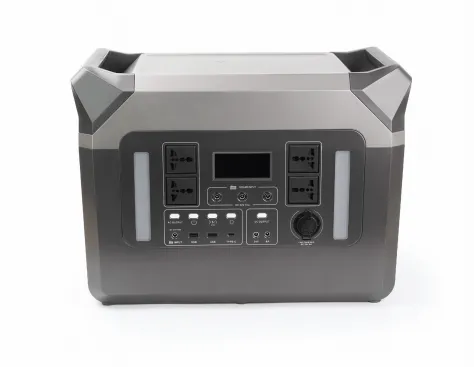
Product Overview
LiFePO4 portable power stations for buyers who need plug-and-play backup, carry-anywhere form factor and drop-in compatibility with consumer devices more than maximum capacity per kilogram. The dominant format in this category is the 1 kWh-class unit — roughly 1,000–1,050 Wh capacity with 1,500–2,400 W continuous AC output, housed in a sub-15 kg enclosure with foldable handle. Larger 2 kWh variants (≈18–19 kg) exist as “wheelable” or two-person-lift products, but the 1 kWh class remains the volume anchor for camping, home emergency backup and mobile work. LFP is the default chemistry in this tier precisely because the unit sits inside a tent, a vehicle cabin or a living room during a blackout — the phosphate-oxygen bond raises the thermal runaway threshold well above NMC, and the flat discharge curve pairs naturally with a BMS that owns state-of-charge estimation.
Key Features
≈1,000–1,050 Wh LFP capacity, 1,500–2,400 W continuous AC output — pure sine wave, with 2× surge capability for motor loads. The PECRON F1000LFP pairs 1,004 Wh with 1,500 W continuous (pure sine wave); the ALLPOWERS R1500 LITE pairs 1,056 Wh with 1,600 W continuous and 3,200 W surge; the Anker Solix C1000X delivers 1,024 Wh with 2,000 W output.
Integrated MPPT solar charge controller — 200–1,000 W solar input, product-dependent. MPPT is standard in this category, not optional; the differentiation lies in the input ceiling and the charge-source mix (AC fast-charge, solar, car port).
UPS switchover in ≤10–20 ms on AC input loss. This is the feature that separates a “portable power station” from a bare battery: pass-through AC with automatic transfer keeps a router, CPAP or desktop workstation alive without reboot.
Smart BMS with overcharge, over-discharge, short-circuit and temperature protection, plus cell-level balancing. BMS data is accessible on-device or via app in most 2026-era products.
Multi-port output matrix — AC outlets, USB-C PD (up to 100 W), USB-A, 12 V car/DC ports, and increasingly an SDC or XT60 expansion port. Port count and PD wattage are procurement discriminators at a given capacity point.
Certification profile is consumer-facing, not industrial: UL 2743 is the core US safety standard for portable power stations; PSE is mandatory for Japan; CE-EMC and RoHS cover the EU; IEC 62619 or IEC 62133-2 applies at the cell/battery level. Confirm the certificate names the finished unit, not only the cell.
Technical Specifications (Typical 1 kWh / 1.5–2 kW Class)
Parameter | Typical value | Notes |
|---|---|---|
Usable capacity | 1,004–1,056 Wh | 2 kWh and 0.3 kWh tiers also exist |
Continuous AC output | 1,500–2,000 W typical; up to 2,400 W in the 2 kWh tier | Surge 2× for 1–3 s |
Cell chemistry | LiFePO4 (LFP) | Cylindrical or prismatic, A-grade |
AC waveform | Pure sine wave, THD <3% typical | Required for inductive and sensitive loads |
UPS transfer time | ≤10–20 ms | Product-dependent; verify against load tolerance |
Solar input (MPPT) | 200–400 W typical in 1 kWh class; up to 1,000 W in 2 kWh class | Input voltage window varies by product |
AC recharge time | 0.8–1.5 h typical with fast-charge | Requires adequate circuit rating |
Cycle life | 3,000–6,000 cycles to 80% capacity, product-dependent | Some premium cells claim 10,000 cycles |
Weight | 11–15 kg (1 kWh class); 18–20 kg (2 kWh class) | Handle-integrated; not backpack-portable above 15 kg |
Operating temperature | Charge 0–40/45 °C; discharge −10/–20 to 40/50 °C | Confirm low-temperature charge cutoff |
Certifications | UL 2743, PSE, CE-EMC, RoHS, UN38.3; IEC 62619 at battery level | Scope must cover the finished unit |
Caveat: Values describe the common 1 kWh / 1.5–2 kW portable class, not every product. A 2 kWh unit will exceed the weight and surge figures above; a 300 Wh unit will fall below them. Use the specific product datasheet for procurement.
Typical Applications
Application | Fit rationale |
|---|---|
Camping & overlanding | 1 kWh covers lighting, device charging, a portable fridge and a coffee maker for 1–2 days; sub-15 kg allows one-person deployment |
Home emergency backup (short-duration) | UPS-mode transfer keeps router, modem, CPAP and a few lights alive through a grid outage; recharge from wall or solar between events |
Mobile work & creator field use | Pure sine wave runs laptops, monitors, cameras and drones; USB-C PD 100 W covers modern notebook charging without an AC brick |
Off-grid cabin / shed | Pairs with a 200–400 W folding solar panel for daily duty cycles below 1 kWh; no fixed wiring required |
Vehicle & RV auxiliary | Car-port charging from 12 V while driving; AC output covers appliances the vehicle’s inverter cannot handle cleanly |
Installation & Maintenance Notes
Installation
Ventilation is not optional even with LFP. The enclosure dissipates heat from both the inverter and the cells; blocking the rear or side vents in a tent, cabinet or vehicle footwell will derate output or trigger thermal protection. Maintain at least the clearance stated in the datasheet.
Do not chain power stations through each other’s AC output to “add capacity.” Parallel AC stacking is not a supported topology in this category; use a single unit sized for the load, or a residential-class system for sustained multi-kWh duty.
Verify UPS transfer time against the load. A ≤10 ms transfer is safe for most IT equipment; a 20 ms unit may drop a desktop PSU or a sensitive medical device. Match the number to the actual load, not to the marketing claim.
Solar input voltage window matters. A folding panel with a Voc above the station’s MPPT ceiling will not charge and may damage the input. Check Voc, not just wattage, before pairing.
Maintenance
Capacity check before each backup season. Discharge a fully charged unit under a known resistive load and compare delivered Wh against the nameplate. A 1 kWh unit that delivers 750 Wh is at 75% state-of-health — adequate for camping, marginal for a medical backup duty.
BMS/app log review monthly during storage. LFP self-discharge is low, but a unit stored at 100% SOC at elevated temperature ages faster than one stored at 50–60%. Most BMS apps report cell voltage spread and temperature history; use them.
Recharge to 50–60% before long-term storage; never store at 0%. A deeply discharged LFP pack that sits for months can enter a low-voltage state the BMS will not recover without a wake-up charge.
Inspect AC inlet, DC ports and vents every 6 months. Dust ingress into the AC inlet or a loose car-port connector is the most common field failure mode in portable units; compressed air and a connector reseat resolve most cases.
FAQs
What distinguishes a portable LFP power station from a small residential LFP module?
The portable unit integrates inverter, MPPT, BMS and enclosure into one carryable package and optimizes for Wh/kg and port count; the residential module optimizes for cycle life, parallel expansion and fixed inverter protocol compatibility. A portable unit is a finished appliance; a residential module is a building block for a wired system.
Which certifications should appear on the portable unit datasheet?
UL 2743 for the US, PSE for Japan, CE-EMC and RoHS for the EU, UN38.3 for transport, and IEC 62619 or IEC 62133-2 at the battery level. Confirm the UL 2743 report covers the finished station, not only the cell.
Can two portable power stations be paralleled for more capacity?
Generally no for AC output. Some 2 kWh-class units support DC-side expansion via a dedicated battery port, but AC paralleling is not a portable-category feature. For >2 kWh sustained demand, move to a residential-class stackable system.
Discuss Your Project
Share your product requirements, estimated order quantity, and target delivery destination.