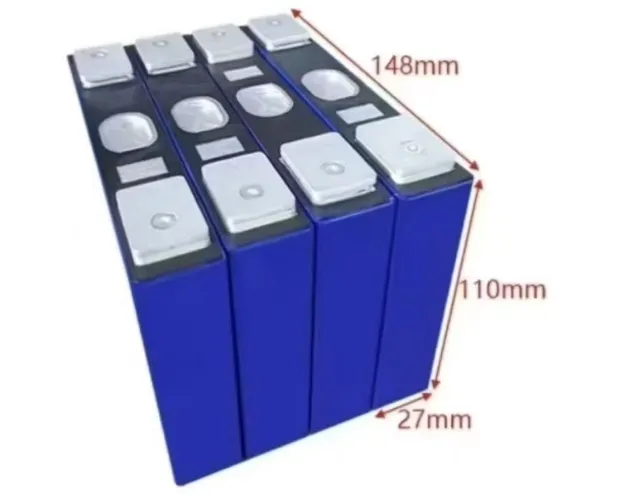
Product Overview
Prismatic NMC cells pair a nickel-manganese-cobalt cathode with a rigid aluminum or steel prismatic housing. They occupy the high-energy-density end of the prismatic spectrum, serving applications where weight and volume constraints outweigh the cost and thermal-management penalties of NMC chemistry. Cells are supplied at component level; liquid cooling, BMS, and pack integration are implemented at module and pack level.
Key Features
- Gravimetric energy density leads the prismatic class. Current Tier-1 prismatic NMC cells deliver 230–255 Wh/kg, roughly 40–50% more energy per kilogram than LFP of equivalent capacity. This directly translates to vehicle range or payload capacity.
- Higher voltage platform reduces system overhead. At 3.7 V nominal, series count is lower than a 3.2 V LFP architecture for the same pack voltage, reducing busbar weight and BMS sense-channel count.
- Liquid cooling is the practical default, not an option. In a review of 21 real-world prismatic BTMS deployments, 80% employ liquid cooling. NMC thermal-runaway onset is around 210°C, versus ~270°C for LFP, and pack design must treat cooling as a safety function, not just a performance feature.
- Cycle life is lower and more condition-sensitive than LFP. Published ranges span 1,300–3,200 cycles depending on supplier and test condition; at 25°C/0.5C/80% DoD, NMC typically sits in the 800–2,000 cycle band. DoD is the dominant lever: reducing from 100% to 80% DoD roughly doubles cycle count in published NMC degradation data.
- Low-temperature behaviour is superior to LFP but not unlimited. NMC charges down to −20°C on commercial prismatic cells, where LFP charging is often restricted above 0°C. Below −20°C, derating and pre-heating remain necessary.
Technical Specifications
Typical cell-level ranges. Exact values vary by supplier, capacity class, and test condition; confirm against the specific datasheet before design lock.
Parameter | Typical Range / Value |
|---|
Chemistry | Nickel-manganese-cobalt (NMC / NCM) |
Nominal voltage | 3.7 V (some variants 3.67–3.74 V) |
Capacity classes | 50–137 Ah mainstream; 218 Ah entering production for high-energy packs |
Gravimetric energy density | 230–255 Wh/kg (capacity- and generation-dependent) |
Volumetric energy density | ~585 Wh/L (117 Ah class); higher for advanced formats |
Operating voltage window | 2.5–4.2 V typical; some high-voltage variants to 4.35–4.4 V |
Cycle life (to 80%) | 1,300–3,200 cycles; test conditions (temperature, C-rate, DoD) must accompany any comparison |
Continuous discharge | 3C on current high-power variants; 1C on energy-optimised cells |
Charging temperature | −20°C to 55°C (prismatic NMC) |
Discharging temperature | −30°C to 55°C (prismatic NMC) |
Thermal-runaway onset | ~210°C (NMC); LFP reference ~270°C |
Certifications (confirm per batch) | UN38.3 (transport); IEC62619 (industrial safety); automotive-grade qualification where claimed |
Typical Applications
- Long-range passenger EV — energy density directly drives range; prismatic NMC is the default where pack volume and weight are binding
- High-performance & premium EV platforms — 3C continuous discharge supports acceleration and gradeability without voltage sag
- Electric buses & heavy-duty trucks — fast charge/discharge capability suits high-utilization duty cycles
- eVTOL, aerospace & racing — highest gravimetric energy density in the prismatic class where every kilogram matters
- Weight-sensitive industrial equipment & robotics — compact footprint and high power output in limited spaces
- Residential & commercial ESS (selected niches) — where energy density or footprint outweighs LFP's cycle-life and safety advantages
Installation & Maintenance Notes
- Liquid cooling is the baseline, not an upgrade. Side cooling has been shown to be the most effective configuration for prismatic NMC, reducing peak temperature materially versus bottom or tab cooling in comparative studies. Design the cold plate as a safety-critical component.
- Keep the operating window in 15–35°C where possible. NMC degradation accelerates above 45°C (SEI growth, electrolyte oxidation) and lithium-plating risk rises below −10°C during charging.
- Compression and terminal torque: prismatic cells require even compression across the face; follow the supplier’s torque specification for terminals. Do not exceed — over-torquing damages the terminal seal.
- Storage: 40–60% SOC, 15–25°C, low humidity for idle periods beyond 30 days. Long-term storage at high SOC and elevated temperature accelerates calendar fade.
- Do not mix NMC with LFP in the same string or pack. Voltage platforms (3.7 V vs. 3.2 V) and thermal profiles differ; a shared BMS cannot manage both correctly without re-parameterisation.