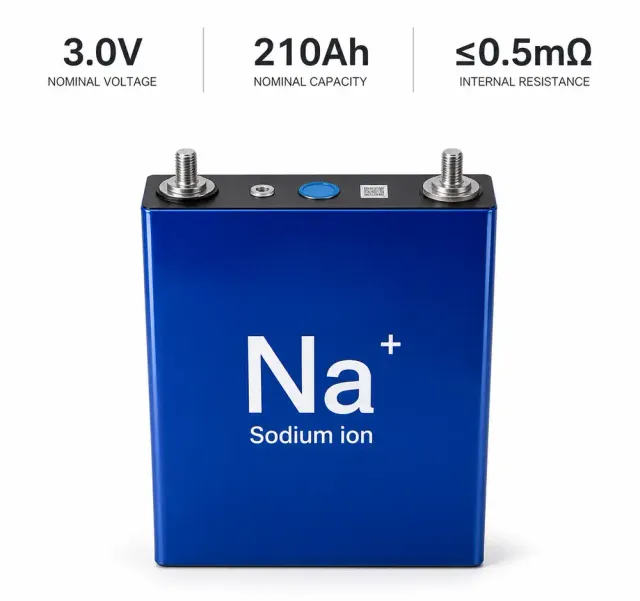
3.2V 210Ah LF280K Prismatic Sodium-Ion Battery Cell
Explore 3.2V 210Ah LF280K prismatic battery cells for energy storage and power applications. Ask about technical specifications, OEM labeling, and customization options.
View Product

Product Categories
Sodium-ion cells use sodium ions as the charge carrier instead of lithium.
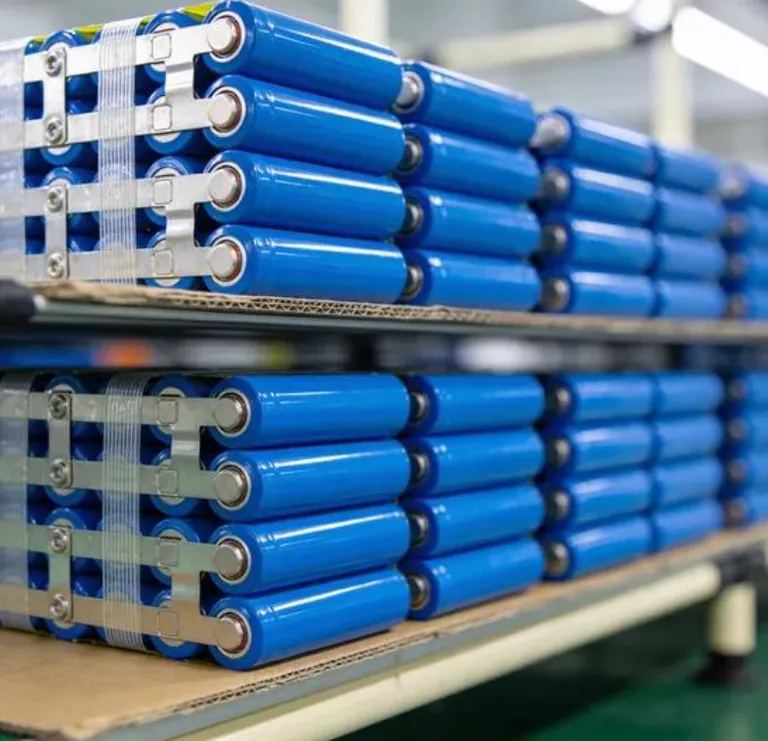
Explore 3.2V 210Ah LF280K prismatic battery cells for energy storage and power applications. Ask about technical specifications, OEM labeling, and customization options.
View ProductSodium-ion cells use sodium ions as the charge carrier instead of lithium. They are commercially positioned where lithium cost, sub-zero performance, and supply-chain concentration are binding constraints. Sodium-ion is not a universal lithium replacement: at cell level, energy density remains below mainstream LFP, and cycle life spans a wide range depending on cathode chemistry. The format wins where cold-climate operation, 0V storage and transport, and material availability create system-level value that offsets the gravimetric penalty.
Three cathode families define the commercial landscape: layered transition-metal oxides (highest energy density, closest to lithium-ion manufacturing compatibility), polyanion compounds including NFPP (structural stability, long cycle life, lower cost), and Prussian blue analogs (low-cost aqueous synthesis, high power capability). Cells are supplied as components; BMS thresholds and thermal parameters must be configured for sodium-ion’s voltage window, not reused from a lithium-ion platform.
Typical cell-level ranges across commercial and near-production sodium-ion cells. Exact values depend on cathode chemistry, cell format, and test condition; confirm against the specific datasheet before design lock.
Parameter | Typical Range / Value |
|---|---|
Chemistry | Sodium-ion; cathode routes: layered oxide, polyanion (NFPP/NASICON), Prussian blue analog |
Nominal voltage | ~3.0–3.1 V (layered oxide and polyanion); lower for some Prussian-blue systems |
Capacity classes | Cylindrical: 10–26.5 Ah; prismatic ESS: 58–165 Ah; large-format: 300+ Ah; automotive prismatic in development |
Gravimetric energy density | 102 Wh/kg (cost-optimised ESS) to 175–190 Wh/kg (automotive/large-format); 261 Wh/kg high-energy variant |
Volumetric energy density | 182 Wh/L (165 Ah ESS cell); 419 Wh/L (588 Ah large-format) |
Cycle life (to 80%) | 3,000–5,000+ (layered oxide); >10,000 (automotive polyanion); >20,000 (NFPP ESS) |
Low-temperature discharge | −35°C: 92.5% of 25°C capacity (cylindrical); −40°C: 51–62% (tested chemistries); −50°C discharge supported on power-grade variants |
Operating temperature window | −40°C to +70°C (CATL NaXin); supplier- and chemistry-dependent |
Storage / transport state | 0V storage and shipping; capable of discharge to 0V without degradation; terminals may be shorted |
Certifications (confirm per batch) | UN38.3 (now with sodium-ion-specific provisions); UL and IEC 62619 where claimed; Class 9 Exempt logistics available from at least one supplier |
No. The nominal voltage (~3.0–3.1V vs. 3.2V) and operating window differ, so series count, BMS thresholds, and charger profile must change. Energy density is lower for most commercial ESS-grade sodium-ion cells (102–190 Wh/kg vs. 160–180 Wh/kg LFP), so a like-for-like volume and weight replacement is not achievable at the pack level.
Specify the cathode chemistry and test condition, not the headline. NFPP ESS cells at >20,000 cycles and layered-oxide cells at 3,000–5,000 cycles are both “sodium-ion cycle life” and neither predicts your duty. Require cycle life at the temperature, C-rate, and depth of discharge the application will actually see.
The 0V capability is a general sodium-ion characteristic tied to the ability to use aluminium current collectors on both sides and avoid copper dissolution at low potential. However, the specific cell’s datasheet remains the governing document for storage voltage, temperature, and duration. Do not extrapolate from the chemistry class to a specific product without written confirmation.
Treating energy density as the first screening criterion. Sodium-ion’s value proposition is sub-zero operation, 0V logistics, and material availability, not gravimetric density. A buyer who screens sodium-ion against LFP on Wh/kg alone will reject the chemistry before evaluating the system-level savings from eliminated heating, simplified transport, and reduced supply-chain risk. The defensible sequence is operating temperature → storage/transport constraints → cycle-life test condition → energy density → certification.
Share your product requirements, estimated order quantity, and target delivery destination.

Hi! Before we connect you to our WhatsApp team, please share 5 quick details.