
Articles
Battery Cell Selection for ESS: Form Factor First, Chemistry Second — and Why the Order Matters
Why form factor should decide your ESS cell before chemistry does. Compare cylindrical, prismatic, pouch, and blade — plus sodium-ion, LTO, LFP, and NMC temperature and cycle trade-offs.
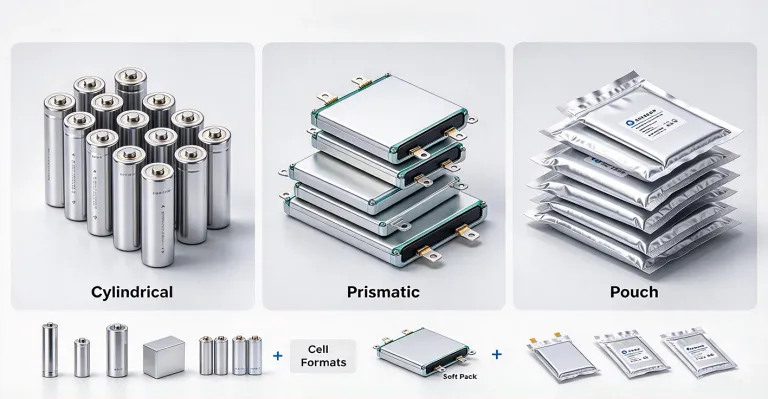
Most cell selection conversations start in the wrong place. They begin with a chemistry — “we want LFP” or “we’re exploring sodium-ion” — and treat the physical shape of the cell as a downstream packaging detail. In stationary storage, it is the other way around.
8 min read · 2 comparison tables · 3 project-type decision cards · for ESS system integrators and cell buyers
The form factor decides what the system can look like before the chemistry ever gets a vote.
The decision that gets locked before anyone opens a chemistry datasheet
Walk through a containerized ESS design review and listen to what gets debated. Cycles. Calendar life. Round-trip efficiency. Thermal runaway threshold. All chemistry questions.
Then look at what is actually fixed on the drawing. The rack pitch. The cooling plate geometry. The busbar routing. The BMS harness topology. The fire suppression zone boundaries. None of these are chemistry decisions. They are form-factor decisions wearing engineering clothes.
A cylindrical cell’s round cross-section means heat leaves radially and predictably — but every cell needs its own holder, its own weld point, and its own contribution to a busbar network that grows with cell count.
Prismatic cells reduce cell-to-cell connections and simplify module wiring — at the cost of pushing thermal management into the hands of the cooling plate. The heat now has to travel through a larger, flatter body, and internal temperature gradients do not disappear because the can is rectangular.
Pouch cells strip away the rigid enclosure entirely — wonderful for gravimetric density, terrible for anyone who assumed the cell could carry its own structural load. They need external compression fixtures to maintain stack pressure and alignment over life.
The commitments are made before the first electrochemical impedance spectrum is measured. The integrator who chose cylindrical has committed to a high-interconnect-count architecture. The one who chose prismatic has committed to a cooling-plate-centric thermal strategy. The one who chose pouch has committed to a compression frame that is not optional.
What the form factor does to the system — and what it quietly takes away
A useful way to read the trade-off is to stop thinking in terms of “energy density” and start thinking in terms of where the system pays for the cell’s shape.
Table 1: Four form factors, four different bills
Format | What it gives the system | What it takes from the system | System-level consequence |
|---|---|---|---|
Cylindrical | Highest manufacturing maturity; best cell-to-cell consistency; short and uniform radial heat path; strong mechanical durability | High cell count; interconnect and weld points scale with cell count; holders and busbars eat into pack-level volume and cost | System cost is highly sensitive to busbar optimization; cell-level energy density advantage may not carry through to pack level |
Prismatic | High space-filling efficiency; fewer cells; more predictable module wiring and mechanical design | Larger cells mean harder internal thermal-gradient and stress management; greater manufacturing consistency and formation pressure | Thermal management shifts from “built into the cell” to “the system must actively provide it”; cooling plate design is no longer a supporting role |
Pouch | High gravimetric energy density; strong shape adaptability; suits compact or non-standard spaces | No rigid enclosure; must rely on external compression fixtures to maintain stack pressure, alignment, and swelling control | System mechanical design complexity moves upstream; compression force is not a nice-to-have — it is a life prerequisite |
High cell-to-pack ratio; outstanding system volumetric utilization; strong cost competitiveness | Advantage is tightly bound to CTP/CTR integrated design; without the module-free context, a long thin prismatic cell loses most of its system-level edge | Format and system architecture must be designed together from day one — you cannot “buy the cell first and think about the pack later” |
The pattern is consistent: every format wins somewhere and sends the bill somewhere else. The bill is not a defect. It is the price of the format’s advantage — payable, but only if the system design is built to pay it.
A cylindrical architecture that ignores busbar optimization will spend its consistency advantage on assembly cost.
A prismatic architecture that treats cooling as an afterthought will spend its packing efficiency on thermal gradients.
A pouch architecture without a properly engineered compression fixture will spend its energy density on cycle-life fade.
Form factor first does not mean “pick a shape and stop thinking.” It means read the shape’s bill before you choose the chemistry that will live inside it.
Now the chemistry enters — inside a box the form factor already built
Chemistry is not a free variable. It is a variable that gets to operate within the temperature window, the thermal path, and the mechanical boundary that the form factor already established.
A sodium-ion cell in a prismatic can is not the same proposition as a sodium-ion cell in a cylindrical can. The prismatic can exposes the cell to a cooling-plate-dominated thermal environment; the cylindrical can gives it a shorter radial escape path. And a chemistry’s low-temperature claim — “works at −40°C” — means something different depending on whether the system can physically deliver heat to the cell, or whether the cell has to survive on its own thermal inertia.
Table 2: Chemistry × format compatibility map
Chemistry × Format | Temperature boundary | Cycle and life profile | What the form factor adds or removes |
|---|---|---|---|
Wide temperature range is manageable, but low-temperature capacity and power drop require system compensation | Cycle life is highly DoD-sensitive: 80–90% DoD is usually the LCOS-optimal range; cycle count drops significantly at 100% DoD | Large-face cooling on prismatic cells supports uniform temperature control, but internal thermal gradients in large-format cells demand a finely designed cooling plate | |
LFP + Blade | Same as LFP, but the system volumetric advantage may be diluted by thermal management needs in wide-temperature projects | Under CTP architecture, cycle life is tied to system integration level; blade ESS use cases have publicly anchored around the 8,000-cycle range | Largest format dividend, largest format constraint: without the CTP context, the blade’s system-level advantage does not exist |
Roughly 90% usable capacity retained at −40°C; chargeable at −30°C; operating window can cover −50°C to 60°C | Cycle life claims reach 15,000–20,000 cycles, but volumetric energy density is lower than LFP | Prismatic space efficiency partially offsets sodium-ion’s volumetric disadvantage; low-temperature strength on large prismatic cells depends more on coordination with system thermal management | |
LTO + Cylindrical | Wide operating range from −40°C to 70°C; high capacity retention even at low temperature | Ultra-long cycle life (20,000–25,000 cycles range), but low specific energy and high initial cost | Cylindrical radial heat dissipation naturally matches LTO’s high-power and wide-temperature characteristics; the cost is that cylindrical interconnect complexity is diluted over a long service life — but not eliminated |
NMC + Prismatic or Pouch | Highest room-temperature energy density, but operability is significantly limited below −20°C; capacity loss from +55°C to −20°C can reach 43% | Cycle life is typically lower than LFP, and the recommended DoD range is narrower (about 60–80%) | Pouch’s high gravimetric density matches NMC, but compression fixtures and mechanical support are hard prerequisites; prismatic NMC has an edge in compact spaces, but its thermal stability window is narrower |
The table is not a ranking. It is a compatibility map.
Sodium-ion’s low-temperature strength is real — CATL’s mass-produced sodium-ion cells hold roughly 90% usable capacity at −40°C and can charge at −30°C. But that strength does not erase the volumetric gap against LFP.
LTO’s 20,000-plus cycles and −40°C to 70°C operation are not marketing numbers. But the energy density penalty is equally real, and a cylindrical LTO architecture still carries the interconnect burden that every cylindrical format carries.
Chemistry decides what the cell can do. Form factor decides what the system has to do to let the cell do it.
Three project types, read backwards from what cannot be tolerated
The cleanest way to make the form-factor-first order operational is to stop asking “which chemistry is best” and start asking “which failure mode is unacceptable in this project.” Then work backwards.
Project type 1: The cold-site container that cannot afford a heating bill
Scene: The site sits below −20°C for extended periods. The project economics do not support a continuously energized heating system.
What fails first: NMC’s operating window closes below −20°C, and its capacity loss across temperature is steep. Sodium-ion’s low-temperature behavior is the differentiator.
Why the form factor still matters: A prismatic sodium-ion cell benefits from a cooling plate that can also serve as a heating plate in a well-designed system. A cylindrical sodium-ion architecture would rely more heavily on the cell’s own thermal tolerance and the uniformity of the enclosure environment.
The order in practice: eliminate chemistries whose temperature floor is above the site’s floor → choose the form factor whose thermal path can be managed with the least active heating → then compare the surviving candidates on cycle life and cost.
Project type 2: The footprint-locked skid where every cubic centimeter is contested
Scene: The available footprint or enclosure volume is fixed.
What fails first: Cell-level energy density numbers that cannot survive a bad pack architecture.
Why the form factor still matters: Blade LFP’s cell-to-pack ratio and system volumetric utilization are structurally higher than conventional architectures. CTP designs have pushed pack volume utilization from 40–50% into 60–80% territory, with blade-specific systems reaching over 50% Vcts at the container level. But this advantage is conditional: it lives inside the CTP architecture. A blade cell treated as a standalone prismatic can is just a long, thin prismatic can.
The order in practice: lock the form factor and the pack architecture together → verify that the chemistry’s cycle life and DoD tolerance fit the dispatch profile → only then compare cell-level energy density.
Project type 3: The high-cycling, low-maintenance site where replacement labor costs more than the cells
Scene: The site is remote. Maintenance windows are narrow. The cost of sending a crew to replace modules dwarfs the unit price difference between chemistries.
What fails first: Any chemistry whose cycle life or temperature robustness cannot meet the maintenance interval without active thermal assistance.
Why the form factor still matters: LTO’s 20,000-cycle class performance and wide operating window are built for exactly this profile. But LTO in a cylindrical format inherits the cylindrical interconnect complexity, and LTO in a prismatic format inherits the prismatic thermal-gradient challenge. The chemistry does not escape the form factor’s bill; it pays it in a different currency.
The order in practice: define the acceptable degradation trajectory and maintenance interval → select chemistries that can meet it without active thermal assistance → then choose the form factor whose system-level cost over that interval is lowest, not whose cell price is lowest.
The order, stated plainly
Form factor first because the form factor sets the thermal path, the mechanical boundary, the interconnect count, and the packing logic. These are the conditions under which the chemistry will either perform or fail.
Chemistry second because chemistry is powerful but conditional. Sodium-ion’s −40°C capability, LTO’s 20,000-cycle tolerance, LFP’s DoD-dependent longevity, NMC’s volumetric density — none of these are system-level properties. They are cell-level properties that the form factor and the pack architecture either amplify or waste.
The order matters because reversing it produces a familiar failure pattern: a chemistry chosen on a datasheet, a form factor accepted as a packaging afterthought, and a system that spends its first year of operation discovering that the bill for the shape was never priced into the project.
Before You Lock the Form Factor, Get the Compatibility Map
Form factor sets the thermal path, the mechanical boundary, the interconnect count, and the packing logic. Chemistry either performs inside those conditions or fails inside them. That is why the order matters — and why the right time to check it is before the rack pitch and cooling plate geometry are frozen on the drawing.
Luoyang Datang Energy Tech Co., Ltd. supplies across the formats in this table — cylindrical LiFePO4 and LTO, prismatic sodium-ion, LFP, NMC, blade, and pouch — not because every project should use every format, but because the right starting point is whichever shape’s bill your system is actually built to pay. Send us your project’s temperature window, footprint constraint, and cycling profile, and we will map them against the form factors that can actually carry them.