
Articles
Why Are Prismatic LFP Battery Cells Widely Used in Energy Storage Systems?
Discover why prismatic LFP battery cells are widely used in energy storage systems, from space efficiency and thermal stability to cycle life and system integration.
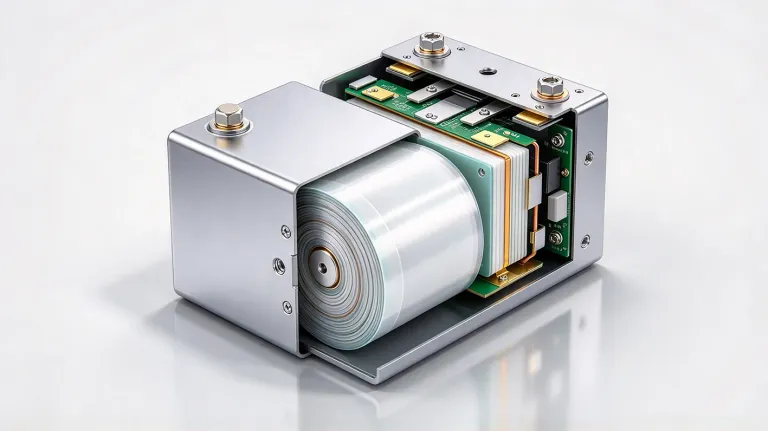
Walk through any energy storage exhibition in 2026, and the hardware tells one quiet story: most stationary battery cabinets are filled with rigid, rectangular blocks—prismatic LFP battery cells—stacked in rows, bolted into modules, and slid into racks.
This is not fashion. LFP chemistry and prismatic format moved to the center of stationary storage together.
Industry statistics illustrate the scale:
- Global battery storage commissioning reached 112 GW / 307 GWh in 2025, up 48% year on year.
- LFP chemistry accounted for more than 90% of stationary battery storage installations worldwide.
- Prismatic cells represented over 97% of energy storage battery shipments from China in Q1 2026.
So the real question is not “why LFP?” or “why prismatic?” separately. It is: why does this pairing fit stationary energy storage so well?
1. What Makes Prismatic LFP Cells Suitable for Energy Storage?
Prismatic cell structure: the packaging advantage
A prismatic battery cell uses a rigid rectangular housing—typically aluminum or aluminum alloy—to contain the electrode stack or jelly roll, electrolyte, and terminals. The rectangular geometry matters more than it first appears.
Key structural points:
- Flat-wound or stacked electrodes fit inside a rectangular case.
- Rectangular faces tile against each other with minimal dead volume inside a module.
- Large-format casings can house high-capacity designs.
- Rigid structure reduces module-level mechanical support requirements.
But be precise: prismatic geometry does not automatically guarantee better system-level space utilization. Real pack-level results depend on cell dimensions, terminal placement, inter-cell spacing, structural members, and thermal design. A poorly matched prismatic cell can waste as much volume as a cylindrical arrangement.
What prismatic format reliably delivers is predictability: a rectangular cell drops into a rectangular slot. For stationary systems engineered once and replicated across dozens of racks, that predictability compounds into engineering-hour savings.
Why LFP chemistry matters: the electrochemical foundation
If the casing determines how the cell is packaged and integrated, LFP chemistry determines how the cell behaves over thousands of cycles and under thermal stress.
LFP uses a lithium iron phosphate cathode. Its strong P–O bond supports thermal robustness and long cycle-life potential. It also avoids cobalt and nickel in the cathode—materials linked to cost volatility and thermal risk.
For stationary storage, the logic is direct:
- Stationary ESS is rarely weight- or volume-constrained like an EV.
- LFP is cost-effective for long-duration and high-cycle duty.
- NMC-type chemistries retain an edge where higher specific energy is the binding constraint.
Takeaway: Prismatic design determines packaging and integration; LFP chemistry determines thermal behavior and cycle-life potential. Neither alone explains the dominance. The combination does.
2. Key Reasons Why Prismatic LFP Cells Are Widely Used in ESS
2.1 High space efficiency and compact module packaging
Prismatic cells maximize space utilization because rectangular faces tile with minimal dead volume inside a module enclosure. For a rack that must fit target capacity into a fixed cabinet footprint, this tiling behavior directly reduces wasted liters.
How prismatic cells support space-efficient ESS designs:
- Regular rectangular form factor — repeatable module slot geometry.
- Flexible arrangement — optimized busbar routing and cooling channel placement.
- Fewer cell-to-cell connections in large-format designs — less assembly labor, fewer failure points.
- Convenient rack integration — prismatic modules slide into standard bays without cylindrical interstitial voids.
Important distinction: module-level space efficiency is not the same as cell-level energy density. A cylindrical NMC cell can outperform a prismatic LFP cell in Wh/L at cell level, yet the prismatic LFP module can deliver more usable energy per installed footprint. For ESS procurement, the metric that matters is usable energy per unit of installed footprint, not the headline cell-level density figure.
2.2 High capacity per cell and simplified system architecture
Large-format prismatic LFP cells span a wide Ah range—from 50–100 Ah formats to several hundred Ah. The architectural result is simple: for a given capacity target, fewer cells are required, which means fewer busbars, fewer joints, and a simpler module BOM.
A concrete reference: a 105Ah 3.2V prismatic LFP battery cell delivers 336 Wh nominal energy per cell (3.2 V × 105 Ah). At approximately 1.98 kg per cell, cell-level gravimetric energy density is in the range of 169 Wh/kg under standard specifications.
Then the hierarchy is straightforward:
- Cells → series/parallel → module with target voltage and capacity.
- Modules → rack.
- Racks → container-scale system.
Caveat: a higher Ah rating does not mean higher cell-level specific energy. A 280 Ah cell and a 105 Ah cell from the same chemistry family can have similar Wh/kg. What changes is system-level simplification—part count, joint count, and assembly complexity. Buyers who conflate “big cell” with “dense cell” make specification decisions on the wrong axis.
2.3 Thermal stability and safety characteristics of LFP chemistry
LFP is not “safe” in any absolute sense—no lithium-ion cell is. But its thermal decomposition behavior differs meaningfully from nickel-rich layered oxides, and the data is specific.
Key benchmark findings:
- Delithiated NCM811 can collapse with substantial oxygen release (~3 wt%) and heat generation (~175 J g⁻¹) below 250°C.
- LFP shows negligible oxygen evolution up to 550°C under the same framework.
- Large-capacity cell studies show NCM cells have lower thermal runaway trigger temperatures, higher peak temperatures, and greater mass-loss rates than LFP under multidimensional abuse.
The mechanism is the phosphate framework. Strong P–O bonds suppress lattice oxygen release, removing one key “fuel” pathway for thermal runaway propagation in nickel-rich chemistries.
But chemistry alone does not make a system safe. System-level safety depends on:
- Stable cell chemistry — LFP provides a favorable baseline.
- Reliable BMS — overcharge, over-discharge, temperature protection.
- Appropriate electrical design — fusing, contactor logic, isolation.
- Thermal management — cell spacing, cooling, temperature monitoring.
- Gas and fire mitigation — venting design, deflagration prevention, enclosure engineering.
Important corrective: system-level studies of large-capacity LFP systems found that under thermal abuse, accumulated combustible gases inside an LFP enclosure can produce severe flashover—even higher fire intensity than an NCM system in the same scenario. LFP changes the risk profile; it does not eliminate fire risk. It shifts engineering attention toward system-level gas management and enclosure design.
Procurement conclusion: LFP lowers the probability and severity of cell-originated thermal events under comparable conditions. It does not reduce the need for BMS, thermal management, or system-level fire engineering.
2.4 Long cycle life and lifecycle cost potential
Cycle life is where LFP’s commercial case becomes tangible. The value is not a single cycle-count number; it is the relationship between cycle life, operating conditions, and replacement frequency.
Published data shows both potential and sensitivity:
- NREL-cited work found LFP cells retained over 80% capacity after 3,000 cycles at 100% DoD and 25°C.
- Gentler cycling windows commonly extend LFP ratings into 4,000–6,000+ cycles.
- Some specified large-format cells are rated up to 5,000 cycles to 80% SOH at 25°C, 0.5C charge/discharge.
Sensitivity matters just as much:
- Increasing discharge rate from 0.5C to 0.8C at 25°C reduced cycle life by ~52.9% under linear extrapolation in one prismatic LFP study.
- A 105 Ah cell rated for 4,000 cycles at 25°C may be rated for only 2,000 cycles at 45°C under the same protocol.
Factor | Impact on cycle life |
|---|---|
Operating temperature | High temperatures accelerate degradation; 45°C can halve rated cycle count versus 25°C. |
Depth of discharge (DoD) | Deeper cycling increases stress; partial SoC windows typically extend service life. |
Charge/discharge rate | 0.5C to 0.8C discharge cut cycle life by ~52.9% in one prismatic LFP study. |
Voltage limits | Operation outside specified cut-offs accelerates degradation. |
BMS management | Keeps cells within specified current, voltage, and temperature windows. |
So the relevant procurement question is not “how many cycles?” but: at what DoD, at what temperature, at what C-rate, and to what end-of-life capacity threshold? A headline cycle count without test conditions is a marketing number, not an engineering specification.
2.5 Flexible integration into different ESS configurations
Prismatic LFP cells integrate along a clear hierarchy: cell → module → rack → container/system. At each level, design choices compound.
What this modularity delivers:
- Capacity scalability without re-engineering — same cell format can serve residential and grid-scale projects.
- Standardized busbar lengths and cooling plate positions — rectangular dimensions simplify module design.
- Repeatable rack units — each with BMS, thermal interface, and electrical protection.
- Factory standardization and field serviceability — critical for 15–20 year assets.
But modularity amplifies cell-to-cell variation. One weak cell in a series string limits the whole string; one high-resistance cell becomes a hot spot under load. Large-format prismatic value is fully realized only when cells inside each module are capacity-matched, resistance-matched, and voltage-matched within tight tolerances.
3. Prismatic LFP vs. Cylindrical and Pouch Cells for Energy Storage
The useful comparison is not “which format is best in general,” but which format’s trade-off profile matches this project’s constraints. First hold this distinction: cell format and cell chemistry are separate variables. A prismatic cell can be LFP or NMC; a cylindrical cell can be LFP or NCA.
Comparison factor | Prismatic | Cylindrical | |
|---|---|---|---|
Physical structure | Rigid rectangular casing | Cylindrical metal can | Flexible laminated film |
Space utilization in module | Rectangular faces tile with minimal dead volume | Unused volume between round cans | Good cell-level density, but requires compression support |
Capacity per cell | Often large formats (50–300+ Ah) | Typically smaller per cell, more cells per pack | Varies by design, often mid-range |
Mechanical protection | Rigid casing provides inherent protection | Strong metal enclosure | Requires external module-level protection |
Thermal management | Depends on cell layout and cooling plate design | Depends on spacing and cooling strategy | Depends on pouch arrangement and compression |
Integration into ESS racks | Well suited to modular rack designs | Often requires more individual connections | Requires careful module packaging |
Why prismatic is often preferred for stationary ESS:
- Regular rectangular geometry supports organized module layouts.
- Large-format options simplify cell-level electrical connections.
- Rigid enclosures fit many stationary battery packaging designs.
But do not overclaim. The best cell format depends on project capacity, available installation space, cooling strategy, mechanical design, and total system cost. For many stationary projects, the balance tilts prismatic—but it is a balance, not a verdict.
4. Where Are Prismatic LFP Battery Cells Used in Energy Storage?
Residential energy storage
Home storage prioritizes safety, compact packaging, and reliable daily cycling. Prismatic LFP modules fit wall-mounted or floor-standing cabinets with predictable dimensions; LFP’s thermal profile reduces enclosure fire-engineering burden compared with nickel-rich alternatives. Typical duty: solar PV storage for evening use, backup during outages, and peak-tariff load shifting.
Commercial and industrial energy storage
C&I systems need peak shaving and load-shifting economics with high cycle throughput, often retrofitted into existing electrical rooms. Large-format prismatic LFP cells reduce cell count per capacity, simplifying DC architecture and reducing joints requiring torque verification and inspection. Rack modularity supports phased capacity additions.
Grid-scale energy storage
Grid-scale systems make the prismatic LFP architecture most visible. Container-scale systems can be assembled from repeatable rack units, each with BMS, thermal interface, and electrical protection. Dimensional regularity supports factory module standardization and field serviceability—critical for a 300 MWh asset maintained over 15–20 years.
ESS application | Main requirement | How prismatic LFP fits |
|---|---|---|
Residential | Safety, compact packaging, daily cycling | Modular format maps to cabinets; favorable LFP thermal profile |
C&I | Capacity scalability, cycle throughput, integration | Large-format cells simplify DC architecture; rack modularity supports phased build-out |
Grid-scale | Long-duration operation, maintainability, reliability | Repeatable rack units with standardized cell dimensions |
Boundary condition: cell format does not determine system discharge duration. Duration is a function of energy capacity, power conversion configuration, and dispatch strategy. Prismatic LFP enables the architecture; the system designer determines duration.
5. What Should Buyers Consider When Selecting Prismatic LFP Cells for ESS?
This section is not a datasheet checklist. It is the questions that separate commodity purchasing from engineered procurement.
Selection factor | What to check |
|---|---|
Nominal voltage | Confirm against system DC bus and BMS compatibility. |
Rated capacity (Ah) | Verify test conditions: temperature, C-rate, cut-off voltage. |
Cycle life | Demand DoD, temperature, C-rate, and end-of-life threshold—not just a headline count. |
Operating temperature | Check both charge and discharge ranges; they may differ. |
Internal resistance | Batch consistency matters more than average value. |
Dimensions and weight | Compatibility with module enclosure, rack bay, cooling plate. |
Check cell consistency, not just specifications
A module is a series–parallel network governed by its weakest element. Put these three metrics in incoming inspection:
- Capacity consistency — matched within a defined tolerance, not broad “grades.”
- Internal resistance consistency — resistance variation drives uneven heat under load.
- Voltage consistency — open-circuit voltage spread after formation and resting indicates process control quality.
Also demand batch traceability and test reports tied to specific production batches, with documented capacity, resistance, and self-discharge data. A certificate of conformity alone is not enough for engineered procurement.
Match specifications with system requirements
Move the purchasing conversation in both directions:
- System side: DC voltage window, target energy capacity, charge/discharge current profile, BMS protocol, thermal interface, module/rack envelope.
- Cell side: nominal voltage, capacity, resistance, temperature limits, dimensional tolerances.
For a 105Ah 3.2V prismatic LFP format, verify not only “does the datasheet say 105 Ah?” but under what protocol, at what temperature, and with what resistance spread across the delivered batch?
6. Are Prismatic LFP Battery Cells the Right Choice for Every ESS Project?
No. A supplier who says yes is not helping the buyer make a good decision.
Prismatic LFP cells may be a strong fit when a project prioritizes:
- Long cycle life
- Thermal stability
- Large-format cell capacity
- Regular module packaging
- Long-term stationary operation
Other chemistries or formats deserve consideration when:
- Higher gravimetric or volumetric energy density is the binding constraint.
- Installation space or weight is severely limited.
- Specific low-temperature or high-power requirements dominate.
- Mechanical or electrical design constraints favor another geometry.
Conclusion: Prismatic LFP cells are not universally best. But their combination of chemistry characteristics, packaging advantages, and system-integration flexibility makes them a strong default for many stationary ESS applications—a default to validate against project constraints, not assume.
Frequently Asked Questions
Q1: Are prismatic LFP batteries better than cylindrical batteries for ESS?
Not universally. Prismatic cells suit regular, large-capacity module designs with fewer electrical joints. Cylindrical cells retain advantages in manufacturing maturity, mechanical durability, and standardized sourcing. The right format depends on project constraints.
Q2: How long do prismatic LFP battery cells last?
There is no universal cycle count. Published data shows 3,000 cycles to 80% capacity at 100% DoD and 25°C in one NREL-cited dataset; specified large-format cells are rated up to 5,000 cycles under 0.5C/0.5C conditions. Actual life depends on DoD, temperature, C-rate, voltage limits, and BMS management.
Q3: What should buyers check before purchasing prismatic LFP cells?
Rated capacity and test conditions; cycle life with DoD, temperature, and C-rate specified; internal resistance consistency across the batch; charge/discharge temperature ranges; dimensions and weight; batch-level test documentation. Headline numbers without test conditions are insufficient.
Explore Prismatic LFP Battery Cell Solutions for ESS
Prismatic LFP is not a universal answer, but for a large share of stationary storage projects, it makes the engineering math work: predictable packaging, a chemistry that tolerates deep daily cycling, and modularity that scales from residential cabinets to grid-scale containers without reinventing the cell.
The productive next step is not a catalogue download—it is a specification conversation. Capacity, voltage window, cycle-life test conditions, consistency tolerances, and integration constraints are where field performance actually lives.
Explore the 105Ah 3.2V Prismatic LFP Battery Cell, or share your system architecture and duty-cycle requirements with Luoyang Datang Energy Tech Co., Ltd. to identify the cell specification that matches your project—not the other way around.